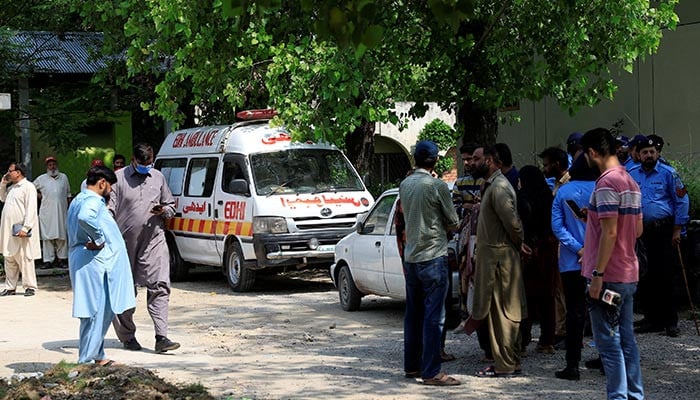
On Tuesday evening, at about ten to seven, a drone was destroyed in the air south of Makkah. The wreckage came down outside the city. Nobody, as far as has been reported, was hurt.
It was the second time in the history of the Yemen war that anything has been fired toward that city. The first was a ballistic missile in July 2017. In the nine years between, through a war that has killed enormous numbers of people and flattened much of a country, both sides left Makkah alone.
That restraint has now been tested, and the coalition’s spokesman responded with two words that deserve examination: red line.
—
A red line is a peculiar instrument. It is a promise made to an adversary about your own future behaviour, and its entire value lies in being believed before it is tested. Once tested, it has only two outcomes, and both are expensive.
If it is enforced, the enforcer escalates a war he was presumably trying to contain — and the escalation is chosen, not forced, which makes him responsible for it in a way he was not responsible for the drone.
If it is not enforced, every future line he draws is worth less, and his adversary has learned something valuable for free.
Col Turki al-Malki did not say what deterrence would consist of. That is the correct thing for him to have said, and it is also the admission that the line is not yet a policy.
—
Now bring it home, because the city in question has lent its name to a Pakistani treaty.
On 7 August, Pakistan, Saudi Arabia and Türkiye signed the Makkah Joint Defence Agreement. An armed attack on one is an attack on all. Five weeks later, something was fired at Makkah.
If a mutual defence pact named for a city means anything, it means something on the day a drone is intercepted over that city. So what did it mean?
The Foreign Office said on 10 September that no military response was under discussion and called the question hypothetical. On Tuesday the DG ISPR was asked how the three countries would respond to an attack on a partner, and answered that “the operationalisation of the defensive commitments had never been made public in any discourse”, and that the three would decide among themselves.
The prime minister condemned the attempt in language of real force — dastardly, heinous, unforgivable, anguish — and then asked all parties to exercise maximum restraint.
—
I want to be careful here, because there is a cheap version of this column and I have no interest in writing it.
The cheap version says: the pact is a fiction, Pakistan has committed to nothing, the words are theatre. That is wrong, and it misunderstands how these instruments work.
Deliberate ambiguity about the trigger is not a flaw in a defence pact; it is close to the whole design. NATO’s Article 5 commits members to “such action as it deems necessary” — each state decides for itself. An adversary who cannot calculate the response has to assume the worst, and that assumption is the deterrent. Publishing the threshold would tell the Houthis exactly how much they can do before anything happens to them.
So “we have not made the operationalisation public” is a defensible answer, and possibly the only professional one.
But notice what it costs. A deterrent that is never specified is also never demonstrated, and a commitment that produces the same sentence on the day of a drone over Makkah as it did on an ordinary Thursday has not, from outside, moved at all. Ambiguity works by being credible. Credibility is built by occasions, and this was an occasion.
—
There is a harder question underneath, which nobody in Islamabad is being asked in public.
Pakistan’s position is that it stands shoulder to shoulder with Saudi Arabia in defence of its sovereignty, and simultaneously that all parties should step back from the brink. Its ambassador told the Security Council on Tuesday that “any attempt to threaten, obstruct, or weaponise the vital waterways will have consequences” — a sentence constructed with visible care to name nobody, because the plural covers both the Houthis at Bab al-Mandeb and Iran at Hormuz, and Pakistan shares a nine-hundred-kilometre border with one of them.
That is not hypocrisy. It is the actual situation of a country that has a treaty with Riyadh, a border with Tehran, a mediating role both accept, and an economy that has added Rs38 to a litre of petrol in ten days because of the fighting.
But those positions are compatible only while nothing is asked of Pakistan. The pact was signed in August, when it cost nothing. A red line at Makkah is the first sign of a month in which it might.
—
What would I want to know, if I could ask one question at the next briefing?
Not what the response would be — that is properly secret. I would ask whether the three governments have consulted since Tuesday evening. Not what was said; simply whether the phone rang.
Because that is the difference between an alliance and an announcement, and it can be answered without disclosing a single operational detail. Five weeks in, with a drone down outside the holiest city in Islam, we are entitled to know whether the mechanism exists.
[Image: Screengrab via The Express Tribune]