
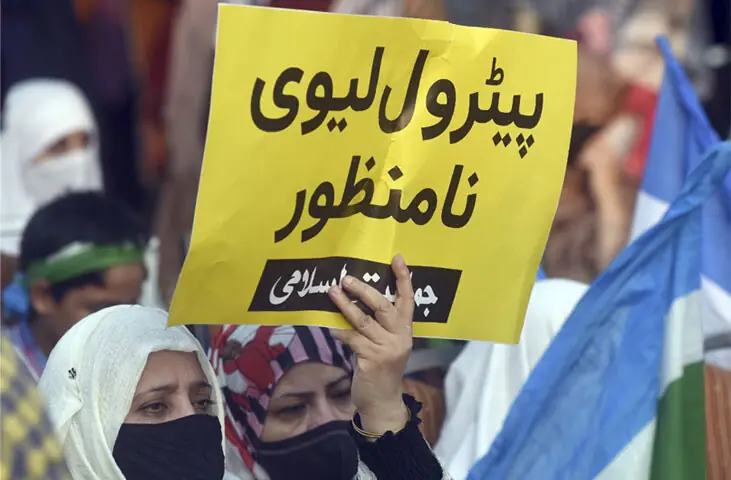
On Friday I wrote that we argue endlessly about the price of petrol and almost never about the tax inside it, and that industry had asked for the levy to be reviewed while no minister had answered.
On Sunday Jamaat-i-Islami announced a long march to Islamabad, on the twentieth, to demand the levy’s abolition. Sit-ins are already running at some forty places. The party puts the take at Rs1,567 billion a year and the burden at Rs130 a litre.
I would like to claim this as vindication and I cannot, because the interesting question is not whether the levy is now political. It is why it took until this week.
—
Consider what has actually changed.
The levy has not. It is a fixed rupee amount per litre, set in the budget, collected whether crude is at sixty dollars or a hundred and five. It was there in June, when nobody marched. It was there in April, when petrol cost Rs458 and was falling. It has been one of the largest single lines in the price of a litre for years, through governments that agreed about almost nothing else.
What changed is the number printed above it. Petrol rose Rs29.95 in five days — 8.7 per cent — and diesel Rs25.27, crossing four hundred rupees. That happened because of a strait two thousand kilometres away that Pakistan has no say in, and because the pricing mechanism now passes it through overnight rather than over a fortnight.
So a constant became visible when a variable moved. That is not irrational. It is how attention works, and economists have a dull word for it — salience — that describes the phenomenon without excusing it.
But notice the shape of what follows. People are mobilising against the component that did not change, because the component that did is beyond reach. Nobody can march on the Strait of Hormuz. The levy is the only part of the price with a Pakistani address.
—
I want to be careful about the figures, because three are circulating and they are not the same number.
Reporting on 8 September put all taxes and duties on petrol at Rs114 a litre. The Korangi Association said on Friday that taxes, duties and levies come to about 37 per cent of the price — roughly Rs137 on today’s Rs375.82. Jamaat-i-Islami says Rs130. These measure different baskets on different days, and none of them necessarily contradicts the others.
What nobody has published is a clean, current breakdown of a litre of petrol: ex-refinery cost, levy, sales tax, dealer and OMC margins, transport. That document exists inside OGRA. Its absence is why a demonstration can be organised around a figure that three sources state three ways, and why the government can decline to engage without appearing to refuse anything.
A protest movement built on a contested number is easy to dismiss. Publishing the breakdown would settle it in an afternoon, which is a reasonable thing to ask for whatever one thinks of the march.
—
There is a version of this column that cheers. A party has finally named the domestic portion of a foreign shock, and that is the argument I said was missing.
There is another version that is more careful, and I think more honest.
The levy is not a scandal. It is a tax, collected in the open, on a good with inelastic demand, in a country whose tax-to-GDP ratio is among the lowest in the region and whose alternative revenue instruments have failed for thirty years. Rs1,567 billion, if the figure is right, is not money that vanishes. It funds a budget that would otherwise be funded by borrowing, or not funded at all.
Abolishing it without naming a replacement is not a fiscal position. It is a wish. And the parties best placed to make that wish are the ones least likely to have to honour it.
That does not make the grievance wrong. A household paying Rs375 a litre while real wages stall is not required to produce an alternative revenue plan before it is allowed to object. But a party asking for votes is, and “abolish the levy” is where that conversation should start rather than end.
—
Here is what I think the week actually demonstrated.
Pakistan’s fuel price has two halves. One is written in the Gulf and arrives overnight, and about it we can do nothing at all — I wrote a whole column three days ago on the lag that turned out not to exist, so I have some standing to say how little control there is. The other half is written in Islamabad, is the size of a small ministry’s budget, and is now the subject of a long march.
People are protesting the half they can reach. That is not confusion about where the pressure comes from. It is the only available response to pressure from somewhere you cannot reach.
The government’s answer, so far, is containers. Fifteen thousand additional police and a thousand containers were requested for the twenty-seventh; about five hundred loaded trucks have already been impounded, their cargo sitting for five days. Now there is a march on the twentieth as well, and the same equipment will have to cover both.
Sealing a city is a response to a march. It is not a response to a number, and the number is what people are marching about.
[Image: Dawn]



