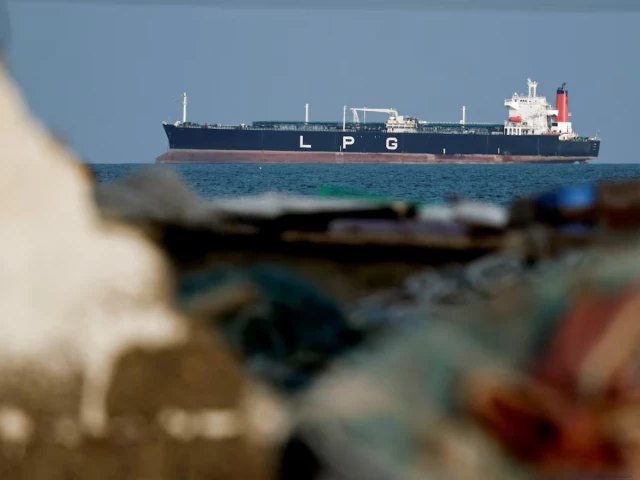
Saudi Aramco is offering crude to Asian refiners by ship-to-ship transfer off Oman’s Sohar port after shutting its east-west pipeline (Express Tribune).
What changed
| | | |—|—| | Pipeline | shut on Friday after drone damage | | Yanbu loadings | suspended | | Ras Tanura and Juaymah | loadings doubled to about 4 million barrels a day | | New route | ship-to-ship off Sohar, outside the Strait of Hormuz | | Grades offered | Arab Light, Arab Medium, Arab Heavy |
Ship-tracking data showed four very large crude carriers, able to carry a combined 8 million barrels, loading at Ras Tanura on Wednesday. European customers received notices of September cargo cancellations.
Why Sohar
Because it sits outside the Strait of Hormuz, on Oman’s Gulf of Oman coast. Crude transferred there has already cleared the chokepoint.
That is the whole logic of the workaround, and it is also its limit: the oil still has to leave the Gulf through Hormuz on the first leg before being transferred. Sohar shortens the exposure; it does not remove it.
The squeeze in one paragraph
Saudi Arabia has two ways out. Hormuz is restricted and under attack. The east-west pipeline to Yanbu on the Red Sea was the alternative, and it has been struck and shut — and Yanbu appeared on Tuesday’s emergency alert list.
So the kingdom is now pushing more volume through the route it built the pipeline to avoid, and transferring it at sea beyond the strait.
The Pakistani footnote
Sohar is the port that Gwadar Port Authority discussed twinning with Gwadar this month, in talks about sister-port status and an MoU yet to be signed. It is currently performing a rather different function.
What is not established
The sources are unnamed people familiar with the matter, plus Energy Aspects and Kpler tracking data. Aramco has not commented publicly. No figure has been published for how much capacity the pipeline shutdown removes or when it will restart.
[Image: Reuters/File via The Express Tribune]