

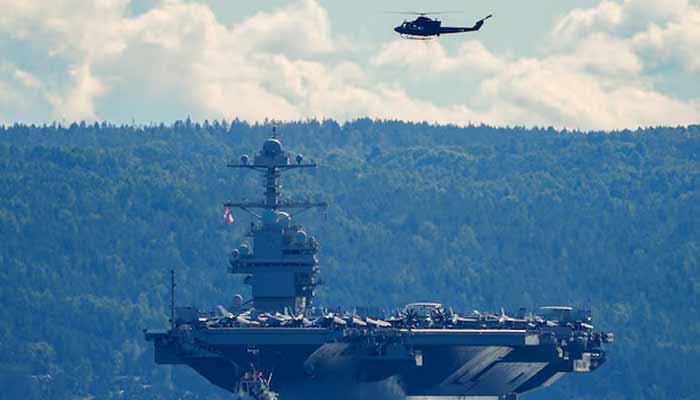
A US aircraft carrier strike group arrived in Latin America on Tuesday, escalating a military build-up that Venezuela has warned could spark a full-scale conflict as it announced its own deployment.
The USS Gerald R Ford, the world’s largest aircraft carrier, entered the US Naval Forces Southern Command’s area of responsibility, which includes Latin America and the Caribbean, the command said in a statement.
The deployment of the vessel was ordered nearly three weeks ago to help combat drug trafficking in the region.
His presence “will enhance the US ability to detect, monitor and disrupt illegal actors and activities that threaten the security and well-being of the United States homeland and our security in the Western Hemisphere,” said Pentagon spokesman Sean Parnell.
President Donald Trump’s administration is waging a military campaign in the Caribbean and eastern Pacific, deploying naval and air forces for an offensive against drugs.
Caracas fears the deployment, which also includes F-35 stealth fighter jets deployed in Puerto Rico and six US Navy ships in the Caribbean, is a covert regime change plot.
President Nicolas Maduro, whose last two re-elections have been dismissed as frauds by Washington and dozens of other countries, accused the Trump administration of “fabricating a war”.
On Nov. 2, Trump played down the prospect of going to war with Venezuela, but said Maduro’s days were numbered.
US forces have carried out strikes on at least 20 ships in international waters in the region since early September, killing at least 76 people, according to US figures.
The Trump administration said in a statement to Congress that the United States is engaged in an “armed conflict” with Latin American drug cartels, labeling them terrorist groups.
Washington has provided no evidence that the ships were used for drug smuggling, and human rights experts say the strikes amount to extrajudicial killings, even if they target traffickers.
‘Inadmissible’
Venezuela announced on Tuesday what it called a major, national military deployment to counter the US naval presence off its coast.
The Defense Ministry in Caracas spoke of a “massive deployment” of land, sea, air, river and missile forces, as well as citizen militias to counter “imperial threats.”
VTVthe state television channel, broadcast footage of military leaders giving speeches in several states.
Such announcements are common in Venezuela these days, but have not always led to visible military deployments.
The experts said AFP that Venezuela would be at a serious disadvantage in a military confrontation with the United States, with an ill-trained fighting force and outdated arsenal.
On Tuesday, Russia denounced US raids on ships from Moscow’s ally Venezuela as illegal and “unacceptable”.
“This is generally how lawless countries act, as well as those who consider themselves above the law,” Foreign Minister Sergei Lavrov said in televised remarks, challenging what he described as a “pretext for the fight against drugs.”
Maduro relies heavily on the Kremlin for political and financial support.
US-Russia relations have soured in recent weeks as Trump has expressed frustration with Moscow over the lack of a solution to the Ukraine war.
The United Kingdom, meanwhile, would not comment Tuesday on a CNN report that it stopped sharing information with the United States about suspected drug-smuggling vessels in the Caribbean because it did not want to be complicit in any attacks.
A spokesman for Prime Minister Keir Starmer told reporters in London: “We do not comment on security or intelligence matters.”
He stressed that “the US is our closest defense, security, intelligence partner” and would not be inspired by the UK’s concerns about US strikes.
“Decisions on this are a matter for the US,” the spokesman said.
a href=”https://www.geo.tv/latest/633179-us-aircraft-carrier-in-latin-america-fuels-venezuelan-fears-of-attack”>Source link



