
KARACHI:
Pakistan’s stock market faced a turbulent week, with the KSE-100 index closing at 113,247 points — a sharp drop of 4,340 points (-3.7%) on a weekly basis. This downturn has stemmed from institutional profit-taking, political uncertainty and recent tax amendments that limit non-filers’ participation in the Pakistan Stock Exchange (PSX).
Despite these challenges, some positive economic indicators emerged, including the World Bank’s expected approval of a $20 billion loan package, the UAE’s $2 billion debt rollover and a 33% year-on-year increase in remittances to $17.8 billion dollars in the first half of FY25. In addition, bond yields fell by 21-50 basis points to their lowest levels since 2022, while the government secured 138 billion. Rs in GIS auctions, mainly through 10-year Sukuk bonds. However, the State Bank of Pakistan’s reserves fell by $15 million to $11.69 billion, and trading volumes and values saw weekly declines of 25% and 27%, respectively.
Political upheavals, speculation dominate
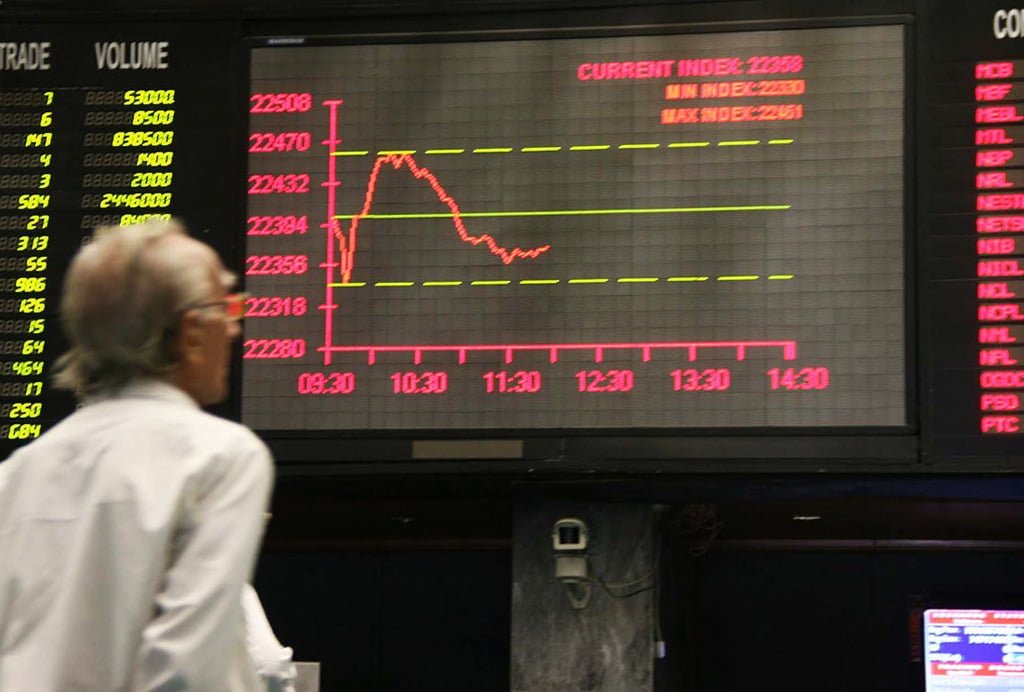
The week got off to a volatile start as the benchmark KSE-100 showed extreme volatility on Monday due to political uncertainty and institutional profit-taking amid IMF-mandated fiscal adjustments. The index hit an intraday high of 1,148 points before retreating to an intraday low of 1,645 points, eventually closing 1.13% lower at 116,255 points. Tuesday followed a similar pattern, with the index trading between 113,677 and 116,843 points before ending the session down more than 200 points. Analysts attributed the market weakness to the depreciation of the rupee, rising geopolitical tensions and the government’s move to unlock a $1 billion IMF tranche.
Midweek, intense selling pressure saw the KSE-100 lose over 1,904 points to close at 114,148. Investor sentiment was further dampened by Prime Minister Shehbaz Sharif’s remarks terming the existing tax slabs as restrictive, hampering business activities under the IMF programme.
Thursday brought another wave of volatility as the index fluctuated between an intraday high of 114,329 and a low of 112,594 before closing at 112,638. A last-hour sell-off contributed to the day’s significant losses, fueled by profit-taking and lingering concerns over the government’s fiscal policies.
Last recovery of the week
The market regained some ground on Friday as the KSE-100 rallied over 600 points to close at 113,247. Investor interest in blue-chip oil and cement companies, driven by rising global crude prices and falling government bond yields, contributed to the recovery. A 29.3% year-on-year increase in December remittances to $3.1 billion and expectations of a rate cut by the state bank later this month also boosted sentiment.
“The market took a pause,” Arif Habib Limited (AHL) wrote in its weekly commentary. The firm noted that the week’s challenges included institutional profit-taking, political instability and restrictions on non-filing investors. However, positive developments—such as the World Bank’s $20 billion package, the UAE’s debt rollover and remittance inflows—had a positive effect.
Sectoral, economic moments
Negative contributions came mainly from banks (-967 points), fertilizers (-603 points), oil trading companies (-534 points), technology (-453 points) and cement (-367 points). In contrast, sugar (+77 points), miscellaneous (+11 points) and REITs (+9 points) provided modest support.
Foreign investors were net sellers, offloading $5.7 million worth of shares compared to net buying of $0.9 million the previous week. JS Global’s Wadee Zaman highlighted the upward revision of Pakistan’s growth forecast for FY25 by the Asian Development Bank (ADB) from 2.8% to 3.0%.
In addition, the government proposed a phased levy on natural gas prices to meet IMF requirements, starting with a 5% increase and escalating to 10%. Textile exports rose 10% to $9.1 billion in 1H25, while the government raised Rs434 billion in bill auctions, with yields declining across the board. The Asian Infrastructure Investment Bank (AIIB) also approved a $500 million loan for the construction of the N5 highway.
a href=”https://tribune.com.pk/story/2521571/turbulent-week-psx-slumps-4340-points”>Source link



