
By Aflatoon
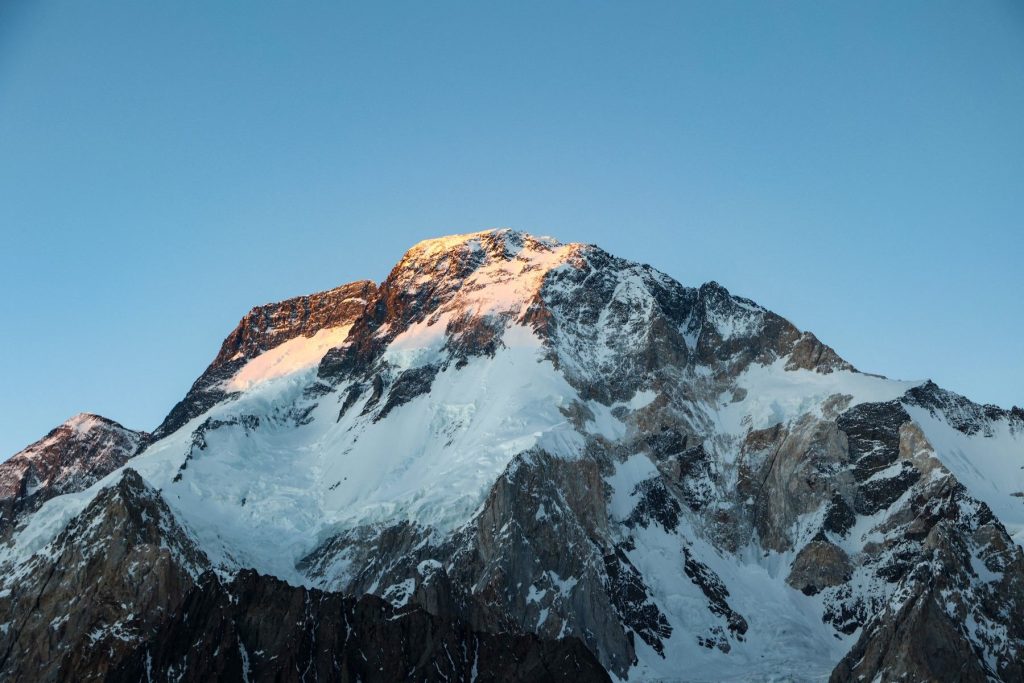
At about nine in the morning on Thursday, an avalanche came down the main west-facing gully of Broad Peak and took ten people with it. All ten are dead.
You will have seen one name. Nirmal Purja — Nims, Nimsdai — was forty-three, British-Nepali, a former British soldier, and the man who climbed all fourteen of the world’s eight-thousanders in 189 days in 2019. Somebody else has since done it faster, which does not diminish it. There is a Netflix documentary. He was, by any measure, one of the most famous mountaineers alive.
The other nine names have travelled less far. Nadhira Al Harthy of Oman. Pur Bahadur Gurung, called Yukta. Nima Sherpa. Mallory Geis, the American, who was thirty-nine and from San Antonio. Sohail Sakhi, the Pakistani guide. A Chinese climber recorded only as Wang. And others whose names, at the time I write this, have still not been published everywhere.
I am not making the cheap point. Purja’s fame was earned in the most literal way available to a human being, and there is nothing improper about the world grieving a person it had heard of. This is not a complaint about the coverage.
It is a note about the mountain.
—
Broad Peak is in Gilgit-Baltistan. So is K2, and Gasherbrum I and II, and Nanga Parbat off to the west. Five of the world’s fourteen eight-thousanders are inside this country’s borders. It is a geological inheritance of a kind almost nowhere else has — Nepal has eight, China shares several, and then there is us.
And what have we made of it?
A permit regime. A few dozen liaison officers. A handful of hotels in Skardu that fill for ten weeks a year. Some of the best high-altitude porters in the world, who are paid a fraction of what the climbers they carry for pay to be there, and who die with a regularity nobody publishes cleanly because the porters are usually recorded as staff rather than climbers.
The industry that has grown around our mountains is largely somebody else’s industry. The expedition companies are foreign. The guiding certifications are foreign. The insurance, the satellite trackers, the helicopters chartered at rates no local outfit could match — all foreign. What we supply is the mountain, the porters, and the army aviation crews who go up when it goes wrong.
—
I want to be careful about the tone here, because ten people have just died and this is not the moment for a grievance essay.
But there is a thing worth noticing about the coverage of this disaster, which is how much of it has been about the danger and how little about the arrangement. A great deal has been written this weekend about avalanche conditions, unstable snowpack, the risks of the west gully in late July. Almost nothing has been written about who assumes those risks and on whose behalf.
The climbers on that slope chose to be there. They were adults undertaking an extreme activity with full knowledge, and the men and women who die on eight-thousanders are, mostly, doing precisely what they wanted to do with their lives. That is worth respecting rather than pathologising.
The people who carry loads to Camp Three for a wage did not choose it in the same sense. They chose it the way a man from Shangla chooses a coal mine in Balochistan — because it is the best-paid work within reach of a village with no other work.
I wrote about that arrangement two days ago, when thirty-four miners died. I did not expect to be writing about the same shape again this week, at eight thousand metres instead of underground.
—
Purja himself understood this better than most people writing about him now. He spent a decade arguing that Nepali guides — the men who fix the ropes, carry the oxygen, break the trail, and then are absent from the summit photograph — should be named, paid and credited. He made a career partly out of insisting that the invisible labour of high-altitude climbing be made visible.
He died on a Pakistani mountain, alongside a Pakistani climber and several Nepali guides, and the invisible labour is invisible again.
—
The bodies are coming down by army helicopter, in weather that has not been cooperating, to a military hospital in Skardu. Two were recovered on Friday. The rest are following as conditions allow.
Somewhere in Gilgit-Baltistan there are men who will go back up that mountain next season, for the season’s wage, because the season’s wage is what there is.
That is the part of this story that will still be true in October.
—
Aflatoon is a satirist and observer of the Pakistani condition. His column, Intellectual Voices, appears in The Pakistan Daily.



