
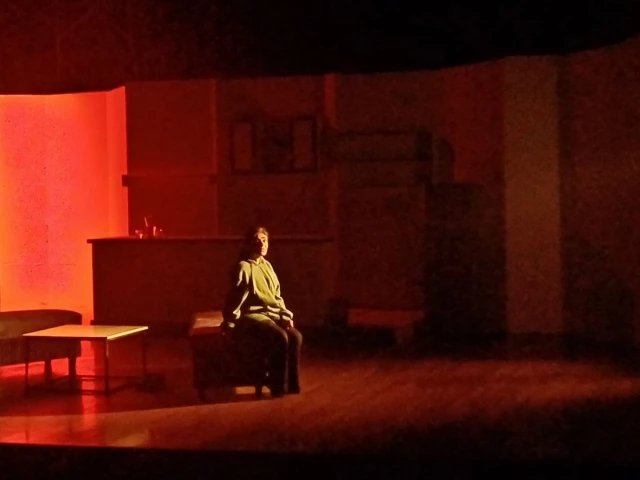
Presented by The Last Show at NAPA on Friday, the play refuses easy villains in a family falling apart
It is rare to sit in a theater and completely forget that you are watching actors on a stage. Usually, you know the lights, the blocking, the performance. But once in a while, a project quietly pulls you in so deeply that you stop noticing the mechanisms altogether.
The Motherwritten and directed by Usama Khan, it did just that for me. It was not based on spectacle or drama. It worked through emotional honesty. Adapted from Florian Zeller’s play of the same name, this version never felt like a foreign story clumsily placed in a Pakistani setting. It felt familiar in the best and most uncomfortable way. The silences in marriages, the emotional distance between parents and grown children, the way families slowly stop talking honestly to each other. You recognize these people. You recognize these rooms. This is what makes the project hit so close to home.
At the center is Haleema, played with heartbreaking restraint by Nimra Bucha. She is an insomniac mother trying to survive loneliness, a fading marriage and the fear of emotional abandonment by her son Arsalan, played by Ashmal, who has moved in with his girlfriend. Her husband Saad, played by Sunil Shanker, is emotionally absent and always away for ‘seminars’. When Haleema’s son stops responding to her messages, something inside her begins to unravel. Pills, alcohol, memory, fear and imagination begin to bleed into each other.
What stuck with me was how the play refuses to turn Haleema into a standard bechari mazloom aurat. She is loving and cruel, needy and manipulative, vulnerable and controlling. Nimra makes her feel almost symbolic of many elderly mothers who feel quietly invisible, emotionally starved and terrified of losing relevance to their children’s lives. The story gently touches on children being neglected by parents as they grow up, the beauty standards surrounding older women, and how overly confused motherhood can sometimes stifle a child’s independence, without ever lecturing the audience.
Usama Khan’s direction keeps you slightly unsettled in the best way. The scenes are repetitive, but they don’t feel the same emotionally each time. Sometimes you’re not sure what’s real and what might be going on inside Haleema’s mind. In a chat after the show, Usama shared why this story mattered to him. “This is a story that belongs in every home. It’s my mother’s story too. Relationships may vary in shape and intensity, but emotional pain is something we all recognize.” He also said that he consciously avoided portraying Haleema as merely a victim. “It would be very easy to show the mother as a happy figure, especially in our culture. But I didn’t want the audience to walk away just saying ‘poor mother’. Instead, he wanted all the characters to live in morally gray areas so that no one felt completely right or wrong. He added, “I never want to force a message on the audience. I want people to see themselves on stage and reflect on their place in life.”
Nimra echoed it beautifully when she talked about discovering Haleema. “The journey of understanding this character is not over yet,” he said. “Sometimes you notice your feelings and sometimes you deal with them. That inner conflict is the real work.” Watching her play, you can feel that tension in every little gesture and pause. The simple, muted set makes the house feel emotionally hollow rather than warm. Haleema’s red outfit stands out sharply against her, like a visual heartbeat.
The supporting performances are equally strong. Ashmal captures the quiet guilt and tenderness of a son torn between love and independence. Sunil Shanker brings restraint and emotional distance to the husband without turning him into a villain. Esha gives Sana confidence and defensiveness, making her feel real rather than symbolic.
The final hospital scene lands quietly but painfully. Haleema survives an overdose, only to learn that her son plans to move in with his partner permanently. There is no dramatic collapse, only stillness and pain. The Mother it doesn’t comfort you. He stays with you. It reminds you that grief often lives in silence, repetition and love that does not know how to let go. And that’s exactly why it’s so real.
a href=”https://tribune.com.pk/story/2586424/the-mother-makes-you-sit-with-the-chaos-we-call-family”>Source link



