
EU dropped language on fossil fuels after Saudi Arabia and others opposed any mention of transition
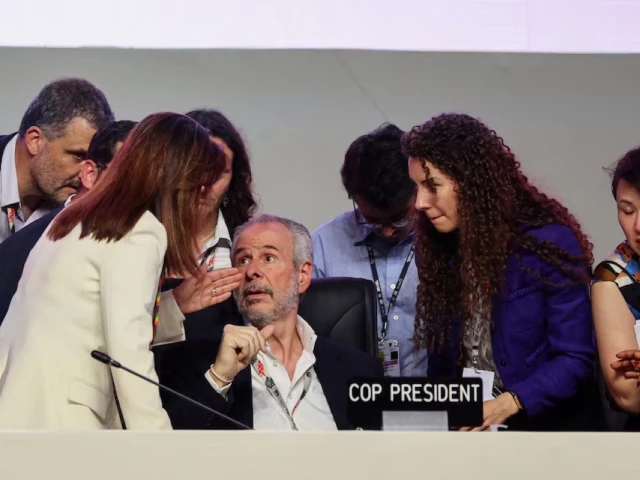
COP30 President Andre Correa do Lago talks to people before the plenary during the UN Climate Change Conference (COP30), in Belem, Brazil, November 22, 2025. PHOTO: REUTERS
World governments agreed on Saturday to a compromise climate deal at the COP30 conference in Brazil that will boost funding for poor countries facing global warming but omit any mention of the fossil fuels that are driving it.
To secure the deal, countries sought to demonstrate global unity in addressing the effects of climate change, even as the world’s largest historical emitter, the United States, declined to send an official delegation.
But the deal, reached in overtime after two weeks of contentious negotiations in the Amazon city of Belem, also exposed rifts between rich and developing countries, as well as between those governments with opposing views on oil, gas and coal. After finalizing the agreement, COP30 president Andre Correa do Lago acknowledged that the talks had been tough.
Read also: “A rise of 2°C will be catastrophic”
“We know that some of you have had higher aspirations for some of the issues you’re facing,” he said.
The European Union was the main holdout on the fossil fuel transition language, but eventually agreed to drop it after a coalition of countries, including top oil exporter Saudi Arabia, said it was off limits.
“We should support (the deal) because at least it’s going in the right direction,” European Union climate commissioner Boepke Hoekstra told reporters before the agreement was finalized.

Some countries had harsher words.
“A climate decision that cannot even say fossil fuels is not neutrality, it is complicity. And what is happening here goes beyond incompetence,” said Panamanian climate negotiator Juan Carlos Monterrey.
Financial support
The agreement launches a voluntary initiative to accelerate climate action to help nations meet their existing commitments to cut emissions and calls on rich nations to at least triple the amount of money they provide to help developing countries adapt to a warming world by 2035.
Brazil’s COP30 President Andre Correa do Lago and Executive Director Ana Toni attend a plenary session during the UN Climate Change Conference (COP30), in Belem, Brazil November 21, 2025. PHOTO: REUTERS
Read more: Turkey is seeking to host the next COP
Scientists said existing national commitments to cut emissions have significantly limited projected warming, but are not enough to prevent global temperatures from exceeding 1.5 degrees Celsius above pre-industrial levels, a threshold that could unleash the worst effects of climate change.
Developing countries have meanwhile argued that they urgently need funds to adapt to the impacts they are already experiencing, including rising sea levels and worsening heat waves, droughts, floods and storms.
Avinash Persaud, Special Adviser to the President of the Inter-American Development Bank, a multilateral lender focused on Latin America and the Caribbean, said the deal’s focus on financing is important as climate impacts grow.
“But I fear the world is still short of more rapid release grants for developing countries responding to loss and damage. This goal is both urgent and difficult,” he said.
Fossil fuel side text
The impasse between the European Union and the Arab Group of nations over fossil fuels had pushed the talks past a Friday deadline, sparking overnight negotiations before a compromise was reached.
a href=”https://tribune.com.pk/story/2578632/global-climate-pact-passed-without-any-mention-of-fossil-fuels”>Source link



