
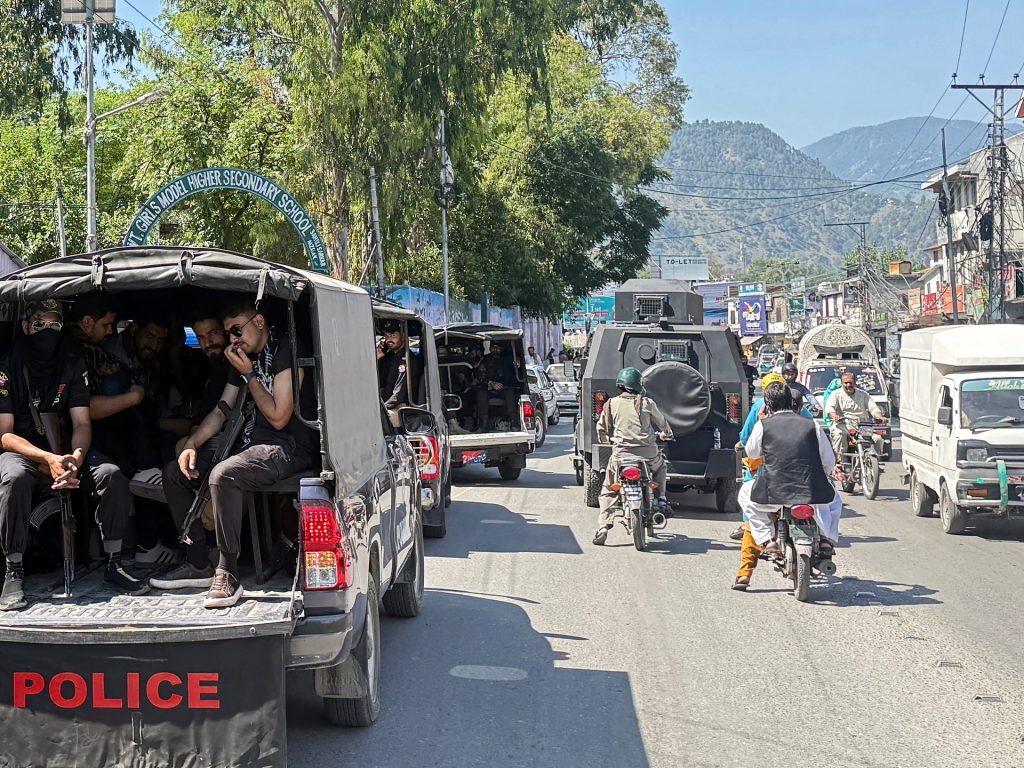
The territory is called Azad Jammu and Kashmir. Azad means free.
In June 2026, its government banned a civil society organisation. Police shot at protesters and eleven civilians died. The internet was cut off for three consecutive days. A popular leader was arrested. Food supplies were disrupted as part of the crackdown. And this week, the country’s largest opposition party announced it would not contest the territory’s elections, because the conditions for a credible vote no longer exist.
The Jammu Kashmir Joint Awami Action Committee started as something quite modest: a protest movement about electricity prices and wheat flour subsidies. The people of AJK — who pay for electricity at market rates but live under an arrangement where Islamabad controls their budget — wanted the same subsidies that other Pakistanis receive. They wanted the price of atta to be affordable. This is not a revolutionary demand. It is the kind of demand that, anywhere in Pakistan proper, would have generated a political response.
In AJK, it generated a crackdown.
Part of what makes the AJK situation so revealing is the constitutional ambiguity that underlies it. The territory is not a province of Pakistan. Its residents do not vote in Pakistan’s national elections and have no seats in the National Assembly or the Senate. They cannot appeal to Pakistan’s Supreme Court. And yet Islamabad controls their finances, their security apparatus, and — in practice — their political environment. The territory is administered but not integrated, governed but not represented.
Pakistan has a strong political interest in maintaining this ambiguity. Formally integrating AJK as a province would carry diplomatic costs in the ongoing Kashmir dispute — it would be read internationally as Pakistan acknowledging that it controls, and therefore should be held responsible for, the territory. So AJK remains in a constitutional in-between: too Pakistani to be independent, too politically inconvenient to be properly included.
The people who live there have been patient with this arrangement for decades. They have produced some of Pakistan’s most distinguished soldiers, civil servants, and academics. They send remittances. They compete in Pakistani universities. They serve on the front lines of every military conflict along the Line of Control.
What they have received in return is cheaper atta in some years, removed in others; an assembly whose twelve seats for diaspora refugees dilute their representation; and, when they protest too loudly, a ban, an internet shutdown, and police fire.
There is a line Pakistan’s security establishment uses when discussing Kashmir: that it is Pakistan’s jugular vein. The metaphor means that Kashmir is existential — that Pakistan cannot survive as an idea without it.
If Kashmir is the jugular, then the people of Azad Kashmir deserve better than what they have been given.



