
COX’S BAZAR:
For the past three years, Mohammad Lalu has been diligently saving, bit by bit, for one goal: to ensure he and his family of eight have $2,000 to cross the Naf River and reach a Rohingya refugee camp in neighboring Bangladesh.
Lalu was not among the estimated 750,000 Rohingya refugees who fled Myanmar in August 2017 to escape what the US and various rights groups have identified as genocide by the Myanmar military.
He was unwilling to leave his village in Buthidaung, a small town in Myanmar’s Rakhine state, and leave his home and farmland.
His area, Lalu told Anadolu, was relatively safe from violence and massacres.
However, after the 2021 coup and the rise of clashes between the Arakan Army’s rebel group and the Myanmar Army, he always feared for his family’s safety and future.
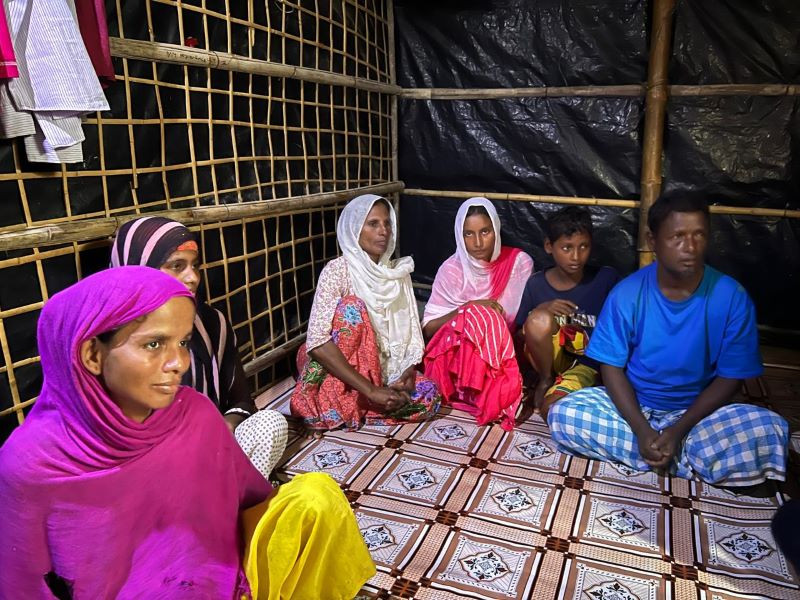
The situation worsened further in November last year when several houses in his village were destroyed by mortar shells and bombs allegedly dropped by drones.
By early August this year, his village and the surrounding area had practically turned into a battlefield.
Despite not having anywhere near the $2,000 needed for the escape, Lalu took a chance and convinced a boatman to attempt the crossing.
“I heard that the Bangladeshi government fell on August 5 and that the border was unguarded, so we tried to cross on August 6,” Lalu told Anadolu in a refugee camp in Cox’s Bazar, southern Bangladesh.
When he reached the Naf River, Lalu saw “at least 100 bodies floating”.
“I was horrified when I learned that drones were bombing people trying to cross on August 5. My family and I hid in a small forest near the coast and made another attempt to spend the night,” he said.
When they moved again, a few hours after midnight, a mortar blast left Lalou with serious injuries to his right leg.
“It was like bombs were falling around us. I lost my leg,” he said.
“One of my brothers was hit in the head and died.”
Lalu is among at least 2,000 people who have successfully crossed the Naf River since August 5, risking death to reach the world’s largest refugee camp in Bangladesh.
Like many law enforcement agencies in the country, Border Guard Bangladesh (BGB) officials had left their posts fearing reprisals when mass student-led protests forced the ouster of former Prime Minister Sheikh Hasina.
At least two BGB officials, who preferred anonymity and were among several who resumed their duties on August 21, confirmed to Anadolu that there had been a “significant influx of new Rohingya refugees since August 5.”
Several officials in refugee camps told Anadolu that the number of 2,000 new arrivals is a conservative estimate and the actual number may be higher.
Sona Mia, 40, also took the same route across the Naf River with her entire family to reach the Hakimpara refugee camp in Ukhia, southern Bangladesh.
“The Arakan army was slaughtering our neighbors and forcibly recruited Rohingya youth. Those who resisted were killed along with their families,” Mia told Anadolu.
He is relieved to be in Bangladesh and hopes for a fresh start.
“At least we no longer fear for our lives and are safe here,” he said
Hope for the Rohingya?
Last Sunday, August 25, was the seventh Rohingya Genocide Day.
At a large rally at Camp 4 in Cox’s Bazar, Rohingya leader Mohammad Alam reiterated their call for safe repatriation and protection of their rights as refugees.
“For the new government in Bangladesh led by Muhammad Yunus, we urge them to first ensure the rights of our refugees and then facilitate our safe and voluntary repatriation,” he said.
Maung Zarni, co-founder of the rights group Free Rohingya Coalition, told Anadolu that he hoped the interim government’s policies on the Rohingya issue would be “kinder and more strategic” than Hasina’s administration.
He said Yunus should take the initial step “to recognize the 1 million survivors of the Rohingya genocide as refugees with rights under international law and as ethnic Rohingya.”
However, Zarni warned that Western countries “will probably not resettle any Rohingya survivors”, pointing to “entrenched racist and anti-Muslim attitudes and policies in Europe, the US, Canada and Australia”.
The West will also “struggle to help Yunus secure meaningful cooperation” from either the Arakan or Myanmar military, he said.
Even if Western actors were willing to help with the conflict in Myanmar, that would not “guarantee the repatriation of the Rohingya,” he added.
a href=”https://tribune.com.pk/story/2491498/bombs-everywhere-rohingya-risk-death-to-escape-escalating-violence-in-myanmar”>Source link



