

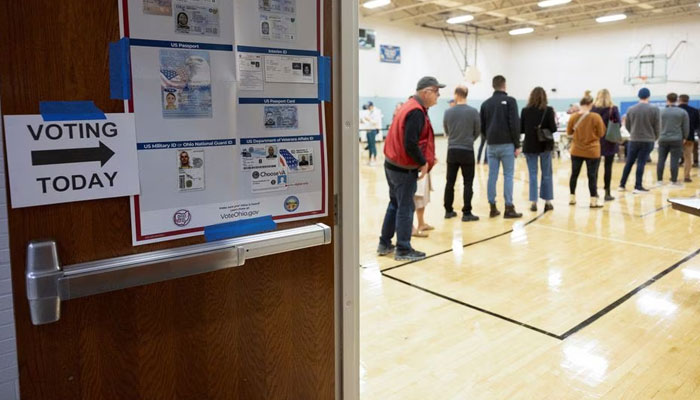
Columbus-area residents Beth and Kyle Long held hands as they entered a Franklin County early voting center to vote on a proposed constitutional amendment that would enshrine abortion and other reproductive rights in the state constitution.
Beth, now 18 weeks pregnant after IVF, is at the same point in her pregnancy as she was in January, when she had an abortion after learning the fetus she was carrying had a fatal condition.
“The doctors came back and told us, ‘all her organs, except her heart, are growing on the outside of her, embedded in the placenta,'” he told NPR. “”[They said] there is nothing we can do to separate it. No fetus has ever survived this condition and yours won’t be the first.’

The Longs appeared in an ad for Issue 1, one of several dominating the airwaves in a contest that many see as a crucial precursor to the 2024 election.
“I think it’s important for us to know that no one else here in Ohio has to go through what we went through,” Kyle Long said before casting his vote.
If voters approve the measure, which is similar to one passed in Michigan last year, Ohio would become the seventh state to approve abortion rights since the U.S. Supreme Court overturned Roe v. Wade last summer.
If passed, the amendment could stop the return of a law banning abortions at the point where fetal heart activity can be detected, as early as six weeks into pregnancy.
A county court put that law on hold a year ago after doctors sued arguing that while it had an exception for the life of the mother, some women were put in life-threatening situations.
The state appealed that decision to the Republican-dominated Ohio Supreme Court, which includes three justices who have publicly declared themselves opposed to abortion rights.
In the weeks leading up to the vote, supporters and opponents of the amendment have been knocking on doors and holding rallies at the Ohio Statehouse.
Aaron Baer, president of the Center for Christian Virtue, says churches are working to repeal the amendment.
“What we’re going to need to win is for the church, the body of Christ, and pro-life activists to rise up and emphasize how radical this abortion amendment is,” Baer says.
Baer echoes the messages of many opponents of the amendment, who say it would repeal state law requiring parental consent or a court order before a minor under 18 can obtain an abortion.
Baer says the “maternal health exception” that allows abortion beyond the point of viability would allow abortions up until birth. Doctors and lawyers disputed this argument.
While much of the opposition’s support comes from Catholic and evangelical churches and organizations, not all churches are aligned.
“For us, it’s an issue of justice, and we follow a God who tells us to care for the health and well-being of all people,” says Katelin Hansen, who leads an outreach program with the United Methodist Church in Columbus.
Prior to 2016, Ohio was considered a swing state. But after twice voting for former President Donald Trump and consistently electing Republicans to control the Legislature, all statewide offices and the Ohio Supreme Court, the Buckeye State is considered to be firmly in the red these days.
However, various polls consistently show somewhere between 55 and 58% of Ohioans support at least some abortion rights.
Republican Gov. Mike DeWine is a staunch opponent of the amendment.
DeWine and his wife, Fran, appeared in a campaign ad, saying the measure “is not right for Ohio and goes too far.”
But DeWine acknowledged that many Ohioans disagree with the six-week abortion ban he signed in 2019, especially after last summer, when it was in effect for 82 days following the U.S. Supreme Court’s Roe decision.
It was during this time that a ten-year-old rape victim went to Indiana for an abortion because she could not have the procedure in Ohio, as the ban does not have an exception for rape and incest.
While DeWine did not propose adding those exemptions back in, he promised voters as they headed to the polls that if they rejected the amendment, he and other state leaders would make an exception for rape and incest.
“The vast majority of people in Ohio think there should be an exemption for rape and incest, so that’s definitely going to be part of what we’re all thinking about if we defeat this thing,” DeWine says.
But that’s a tough sell to amendment advocates like Lauren Blauvelt with Ohioans United for Reproductive Rights.
“The governor and other politicians have had a decade to discuss what would make sense,” Blauvelt says.
In addition to the governor talking about possible adjustments to sway voters to the “no” side, Statehouse Republicans have taken other actions to try to overturn the amendment. Knowing that abortion will be on the ballot in the fall, Republican lawmakers put a measure on a special vote in August to change the constitution to require a 60 percent approval threshold for constitutional amendments instead of a simple majority. It failed.
Then Ohio’s ballot board, controlled by Republicans who oppose abortion rights, approved controversial summary language that voters will see on this current ballot.
This language, which differs from the actual language of the amendment, omitted part of the amendment dealing with birth control and changed the word “fetus” to “unborn child.”
The Ohio Supreme Court allowed most of this controversial ballot language to stand.
The head of the election board, Secretary of State Frank LaRose, is one of the Republicans running in the primary to challenge Democratic US Sen. Sherrod Brown next year.
LaRose recently removed 27,000 voters from the rolls during the early voting period. LaRose’s office said they removed the records for them
a href=”https://www.geo.tv/latest/517976-ohio-voters-to-decide-on-constitutional-right-to-abortion”>Source link



