
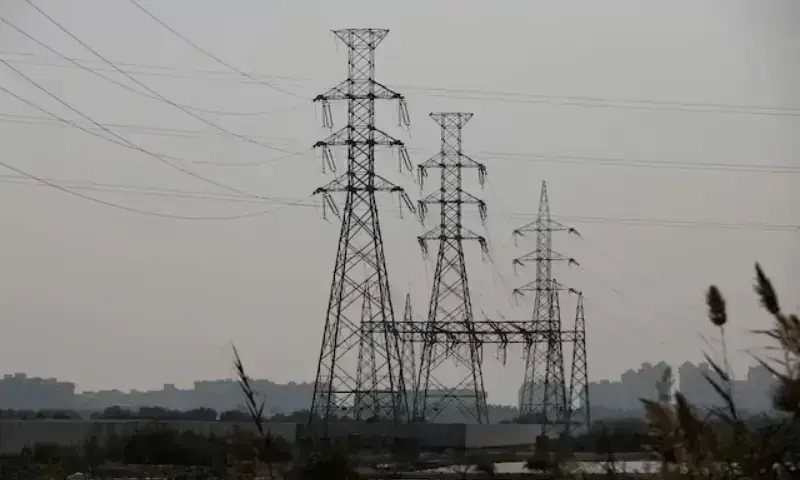
Nepra has approved uniform use-of-system charges for bulk power consumers across all distribution companies, clearing a long-standing obstacle to a competitive electricity market (Dawn).
What was approved
Charges of Rs6.23 to Rs19.62 per unit, covering transmission, distribution, grid charges and cross-subsidies.
| Consumer category | Charge | |—|—| | Industrial (B-3/B-4) | Rs6.23-9.09/unit | | Small distributors (C-2/C-3) | Rs14.95-19.62/unit | | Fixed grid charge | Re1/kW/month | | Loss factor at 11kV | 8.04pc | | Loss factor at 132kV | 1.51pc |
What it unlocks
Under the Competitive Trading Bilateral Contract Market, open-access consumers can buy electricity directly from private suppliers instead of only from their distribution company. More than 3,000 bulk consumers become eligible.
An initial 400MW auction follows, part of an 800MW two-phase rollout. ISMO is to publish the auction calendar and procedures this month.
The principle Nepra applied
“The regulator said the key principle was to ensure that UoSC applicable to open-access consumers remained equal to those applicable to similarly placed consumers of suppliers of last resort.”
That sentence is the whole design. If large industrial users could exit to cheaper private power and escape the cross-subsidy embedded in their tariff, the burden would fall entirely on households and small commercial users left behind. The uniform charge is what stops the exit from becoming a subsidy transfer.
Whether it works is a different question
Setting the charge equal on paper does not guarantee it is set at the right level. If the charge is too low, the subsidy leaks anyway; too high, and nobody leaves and the market stays theoretical. Only the auction results will show which.
The IMF frame
Both milestones — auction guidelines by December 2024 and the uniform charge by January 2026 — were structural benchmarks, and Pakistan met both early. That is genuinely unusual, and worth recording as such.
Scale check
400MW against a national installed capacity in the tens of thousands of megawatts is a pilot, not a liberalisation. It is the first real one.



