
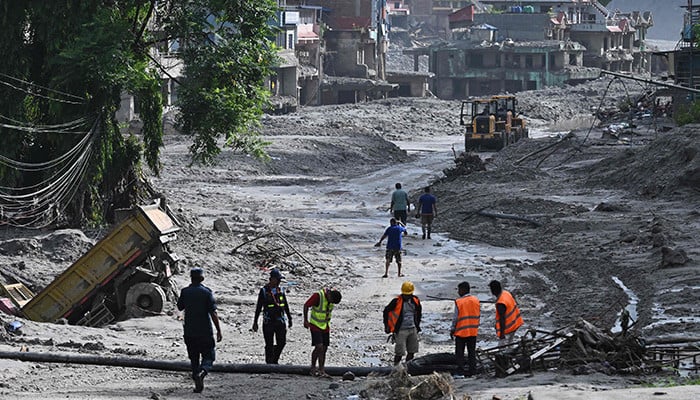
Nepal Police had recovered 768 bodies by 2pm on Sunday, five days after a glacier collapse on Langtang Ri sent ice, rock and mud down the Bhotekoshi and Trishuli rivers (OnlineKhabar).
The ladder, and why the wires disagree
Three different numbers were live on Sunday, and each belongs to a different issuing body and hour.
The National Disaster Risk Reduction and Management Authority put the Nepal toll at 734 with 2,498 missing in its 9am bulletin (Kathmandu Post). Its 1pm bulletin raised that to 752 bodies and 2,502 missing, with 8,730 rescued (OnlineKhabar). Nepal Police, counting an hour later, had 768.
Tibet is a separate count. Officials in Gyirong County told a press conference that 16 had died there as of Saturday evening, with 546 missing (Express Tribune/Reuters).
That resolves the gap between outlets. Geo’s headline figure of 734 is Nepal only; Dawn’s 750 is 734 plus Tibet’s 16, and its “over 3,000 missing” is 2,498 plus 546, or 3,044 — a cross-border total (Dawn). Geo’s own body carries both 750 and 3,044, under a headline that still says 734 (Geo News/AFP/Reuters).
Take the freshest figure from each authority instead and the sums move again: Nepal Police’s 768 plus Tibet’s 16 is 784 dead, and NDRRMA’s 2,502 plus Tibet’s 546 is 3,048 missing. Those two totals are The Pakistan Daily’s own arithmetic across separate counts, not a figure any authority has issued.
The Pakistan Daily reported 633 dead on Saturday. Tibet’s missing has since fallen from the 558 Reuters reported on Saturday to 546, while its dead rose from seven to 16. India has recovered seven bodies from rivers flowing out of Nepal; they are in no official toll (Geo News/AFP/Reuters).
Who is missing
NDRRMA’s list includes 933 people linked to hydropower projects, 589 foreign nationals, 127 Nepalis travelling with them and 85 security personnel. Rasuwa alone reports 562 unaccounted for (Kathmandu Post). China named its missing foreigners for the first time: 261 from 23 countries, including 104 Nepalis, 49 Indians, 33 Latvians, 18 Americans and 15 Britons (Express Tribune/Reuters).
The tunnels
No one has been reported brought out of Upper Trishuli 3A since Friday, when Nepali Army spokesman Rajaram Basnet said crews opened an exit point there and rescued four people (OnlineKhabar). Rescuers have still not broken through into the tunnel itself. Teams have drilled five openings simply to push air in, and hit rock looking for the tunnel slab. Lawmaker and tunnel expert Shriram Neupane, leading the effort on site, told OnlineKhabar they are now considering explosives (OnlineKhabar). The Nepal Electricity Authority estimates 40 to 42 technical staff were inside overhauling the underground powerhouse; work at that tunnel only began on Friday. NEA deputy executive director Madan Timsina says 3A has two access tunnels, both buried, and neither has been opened (OnlineKhabar).
The lake, and what is stopping the search
China’s water resources ministry said on Sunday that the lower barrier lake — about 2 million cubic metres — has fully drained naturally (Kathmandu Post). But CCTV says drones detected a landslide late on Saturday 2.8km downstream of the lake, forming a new dam and a fresh pool of water (Express Tribune/Reuters).
Fresh rain lifted the Trishuli again on Sunday, pushing rescuers and residents to higher ground (Express Tribune/Reuters). Erosion and a landslide at Krishnabhir have closed the Muglin-Kathmandu section of the Prithvi Highway (Kathmandu Post); 13 bridges are gone inside Rasuwa, and only the Pung Khola bridge still reaches Dhunche (OnlineKhabar).
Only 20 of 669 bodies had been identified by relatives as of Saturday evening, and 211 were recovered as mutilated, partial or severed remains, Nepal Police spokesman DIG Abi Narayan Kafle said (Kathmandu Post). Families waiting at the Trishuli barracks say the excavation is running at office hours and stops before dark (OnlineKhabar).



