
By Aflatoon
On 1 August, India’s ambassador to Washington published a column about a river in Newsweek. On 28 August, Pakistan’s ambassador to Washington published his answer in the same magazine.
I have read both, in full, on the magazine’s own pages. What interests me is not who wins.
—
Vinay Kwatra’s case first, and at full strength, because there is a cheap version of this column.
He says the 1960 treaty divided six rivers unevenly: India took the three eastern rivers, carrying roughly 20 percent of the basin’s water, and Pakistan the three western rivers, carrying roughly 80. He says that asymmetry stifled development in Indian regions for decades, and that India honoured the treaty anyway (Newsweek).
He says Pakistan answered with wars in 1965, 1971 and 1999, and with attacks he lists by name — Parliament in 2001, Mumbai in 2008, Uri and Pathankot in 2016, Pulwama in 2019, Pahalgam in 2025. He puts the Indian civilian toll at over 40,000. That is his figure, in his column, and I have not been able to source it elsewhere.
He says Pakistan bogged Indian projects down in endless proceedings, attacked the project sites themselves — he cites a 2012 attack on the Tulbul Navigation Project that he says completely prevented India from exercising its rights — and blocked renegotiation in light of six decades of technological change.
Then the move that is actually the strongest thing in the piece. The treaty’s preamble says it was concluded “in a spirit of goodwill and friendship.” Kwatra writes that Pakistan spent half a century dismantling that goodwill, and that “the abeyance merely acknowledges what Pakistan’s conduct had already destroyed.”
He quotes the prime minister: “Terror and talks cannot go together… Terror and trade cannot go together…. Water and blood cannot flow together.”
And he ends on Pakistan’s own irrigation. Of the water Pakistan receives, he writes, only about 40 percent reaches its farms; more than 30 percent is lost in transit; the rest drains unused into the sea. I did the addition. It closes.
That is a serious column. It is not a foil.
—
Rizwan Saeed Sheikh’s answer is a different kind of document (Newsweek).
He does not dispute the 80/20 split. He disputes what it was. The treaty was “neither an act of Indian generosity nor a concession to Pakistan” but a negotiated settlement designed “to replace upstream discretion with clearly defined and binding rights and obligations.” Pakistan gave up its historic dependence on the eastern rivers and rebuilt its irrigation system to match.
He says the limits on India’s use of the western rivers were not a penalty but the bargain — the price of an upstream state getting certainty from a downstream one.
He says going to dispute settlement under Article IX is not obstruction. It is the treaty working. India, he writes, “cannot reasonably claim the benefit of the Treaty’s provisions permitting hydropower development while dismissing the technical limitations and dispute-resolution procedures that form part of the same negotiated framework.”
Then his own load-bearing sentence. The treaty “contains no provision allowing either party unilaterally to suspend it, place it ‘in abeyance,’ or terminate it.” Article XII, he writes, says it continues in force until ended by a ratified treaty between both governments.
That is the whole legal case, and it is a narrow one. It does not require India to be virtuous. It requires the text to say what it says.
—
Now hold the two columns next to each other and notice what is missing from each.
Kwatra does not use the word “Article” once. Not Article IX, not Article XII, not any article. He refers to the treaty’s machinery only as delay.
Sheikh does not use the word “Pahalgam” once. Twenty-six people were killed there, and the abeyance was announced the day after. His column disposes of it as “baseless allegations of terrorism.” He does not answer the 40 percent figure either. He does not answer the renegotiation point.
So one column argues history and grievance and never touches the law. The other argues the law and never touches the history. They are not having the same conversation.
They meet at exactly one place, and it is worth marking. Kwatra says the treaty rested on goodwill and the goodwill is gone. Sheikh writes that the treaty’s resilience “has rested not on political goodwill, but on the fact that it replaced unilateral discretion with binding rules and procedures for resolving disputes.” That is a real answer to a real point. It is also the only one.
—
Neither man names the Permanent Indus Commission.
Neither names the neutral expert. Sheikh comes closest — he writes of seeking “neutral determination or arbitration” — but he does not use the treaty’s own term for the office. Neither says The Hague. Sheikh names the Court of Arbitration once, and only to say it has affirmed him.
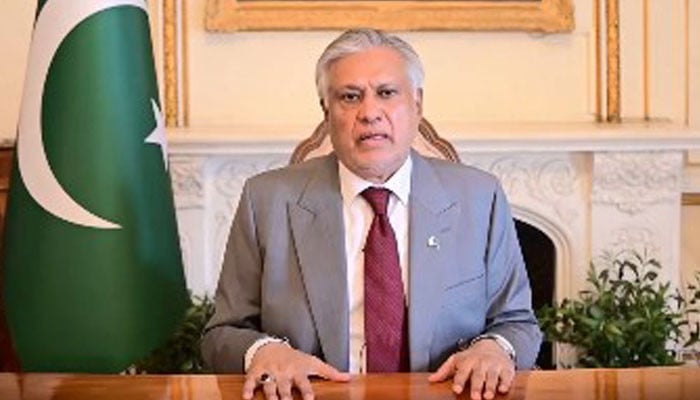
The treaty built those things for this. Two states with a river between them and no trust, so you put a commission in the middle and you write down who decides. That architecture, the deputy prime minister told a Washington seminar on the same Friday, “was not incidental to the treaty. It was central to the bargain” (Geo News). Ishaq Dar said it by video link, Dawn reports — to a seminar Pakistan’s own embassy had organised, in a city where both ambassadors already work (Dawn).
Sheikh cites a Supplemental Award of May 2026 as backing him. I tried to retrieve it and could not; the arbitral registry would not open for me. So I am recording it as his assertion, unverified, which is not the same as untrue.
—
The treaty is not terminated. India has said it is “in abeyance,” a word the text does not contain, and that is where it sits.
What I keep returning to is the venue. The commission is silent and the magazine is not. Two ambassadors, accredited to a third country, writing in that country’s press, in that country’s idiom, for readers in that country — about who owns the water under Punjab.
The audience is the finding. Whatever either government believes about Article XII, both have concluded that the useful place to be heard is Washington.
—
Aflatoon is a satirist and observer of the Pakistani condition. His column, Intellectual Voices, appears in The Pakistan Daily.



