
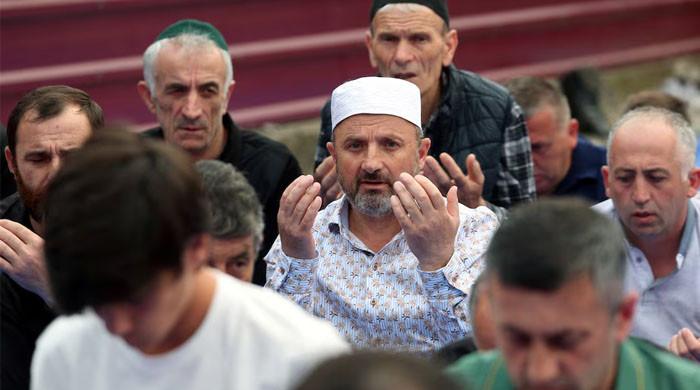

In the village of Ghorjomi, Georgia, Friday’s prayers at the local mosque are always full, says Imam Tamaz Gorgadze.
Located in the remote valleys near the Turkish border, Ghorjomi – and the surrounding area of Upper Adjara – is a rare Islam prison in one of the most pious Christian countries in the world.
“We live in Georgia, a multilevel country,” he said Reuters In June, after prayers for the Eid Ul-Adha religious festival.
Georgia was the second country in the world to adopt Christianity as a state religion around 319, behind neighboring Armenia.
It remains piously Christian and the national identity is closely linked to centuries of struggle against Muslim Persians and Turkish invaders.
Still today, the Muslim Georgians of Adjara are called by some “Tatars” by some, referring to a Muslim ethnic group in Russia.
According to census data, about 10% of Georgia’s 3.6 million people are Muslim. Most of them belongs to the main minority of Shiite Azerbaijan.
But ethnic Georgian Muslims, unique in Adjara, are rarer and more controversial in a country whose national flag consists of five Christian crosses.
The strong Orthodox Church of the country is considered a guardian of the Georgian identity and for many, participation in the Church is a prerequisite for the real Georgian.
However, for the Upper Adjara Georgians, who have turned into Islam over the centuries that were spent as part of the Ottoman Empire, there is nothing contradictory to be both a Muslim and a patriotic Georgian.
“We are proud to be Georgians, we have a common past,” said Tariel Nakaidze, an indigenous Gigiouras and head of the Georgian Muslim Union.
Nevertheless, said Nakaidze, Georgian Muslims are experiencing social pressures that were likened to anti-religious campaigns under the Soviet Union.
He said: “During the Soviet Union in Georgia, both Christians and Muslims had to live a double life.
“Unfortunately, after the collapse of the Soviet Union, this problem was replaced by the Orthodox Christian religion.”
Adjaran Islam comes with clearly Georgian flavors. Central to local Muslim life are Adjara’s distinctive wooden mosques.
Their outer irons with corrugated iron to protect against the winters of the mountain, in the inner mosques of Adjaran have complex wooden sculptures, painted in a mixture of traditional Ottoman and Georgian designs.
Under the shore of the Black Sea, 100 kilometers [62 miles] From Ghorjomi, Batumi, Adjara’s capital and the second city of Georgia sits.
A crazy seaside city of a casino resort and nightclubs that mainly supply tourists from the former Soviet Union, the Batumi Mosque Churches are swollen by visitors from the Turkish border, 20 kilometers[12km[12Miles)Awayaswellasbymiddleeasterntourists[12μίλια)μακριάκαθώςκαιαπότουςτουρίστεςτηςΜέσηςΑνατολής[12miles)awayaswellasbyMiddleEasterntourists
The space is so limited that pilgrims are often forced to pray on the street.
Batumi Imam Tamaz Geladze is trying to expand the elementary, lean mosque for years. Although the authorization has been granted by the authorities, the project remains tied to bureaucracy.
However, Geladze said he had been assigned the story of agriculture tolerance to religious minorities.
“We have co -existed here for centuries, in friendship and dialogue.”
“The diversity of agriculture is a treasure,” he added.
a href=”https://www.geo.tv/latest/613541-in-deeply-christian-georgia-a-muslim-minority-upholds-its-patriotism”>Source link



