By Aflatoon
Two launchers on a small island, and a number on a signboard in Rawalpindi.
Most of what is said about the line between them is wrong in one of two directions. Either the strait is a switch and the pump is a light, or the two have nothing to do with each other. The truth is duller and more useful than both.
—
On Sunday, US forces struck two launchers on Larak Island, inside the Strait of Hormuz near Bandar Abbas. Washington said they were being prepared to fire rockets carrying sea mines into the waterway.
By 0241 GMT on Monday, Brent was at $90.61 a barrel, up $2.51. WTI was at $85.53, up $2.13. Both measure against Friday’s settlements of $88.10 and $83.40, and both reconcile.
Before the war began on 28 February, the strait carried oil and gas equal to about a fifth of world consumption. Ship-tracking data now puts flows at roughly a quarter of pre-war levels, with about five visible commodity vessels a day over the weekend.
That is one end of the line.
—
The price you paid this morning was set on Saturday.
Ogra’s price build-up is headed “Petrol (MS) Price Effective 29 August 2026, 00:00 hours.” Petrol Rs342.02 a litre, high-speed diesel Rs371.44. I checked Ogra’s price publications page while writing this: nothing has been posted effective 30 or 31 August. The sheet of the 29th is the sheet in force (Ogra).
Which means the price in every pump in the country today was fixed before the strike happened.
—
Now the mechanism, in Ogra’s own words, because the words are precise and nobody quotes them.
Line A of the petrol sheet is not Brent. It is the Platts Arab Gulf mean for gasoline, 92 RON, at $105.44 a barrel — “seven working days’ rolling average.” Line D is the exchange rate, Rs277.68, also a seven-working-day rolling average. The diesel sheet runs off Dubai crude at $93.57 plus a distillate crack of $41.89.
The number on the news is not the number in the formula, and neither enters whole. At the foot of the sheet, Ogra states the rule plainly: “Full impact of revision in daily international price is passed-on in seven working days.”
A rolling seven-day mean is not a transmission belt. It is a shock absorber. Monday’s spike is one day of seven in an average, and by the time it is fully in the price it will be the second week of September and the world will have moved.
I cannot tell you that Sunday’s strike will raise Pakistani petrol on any date. Nobody can. That is not a hedge; it is what a seven-day mean is for.
—
Something else in the publication list, which I did not expect and have now checked date by date.
In August, Ogra published a price build-up on eighteen days. Not one of them was a Sunday. Not one was a Monday. Every Sunday and every Monday of the month is blank, without exception — the Platts working week sits behind the formula, and the weekend passes through it unchanged.
So the “daily” price has a weekend. Saturday’s sheet carries the country through Sunday and Monday.
The strike was on a Sunday.
—
The rest of the sheet is worth reading downward, because it settles an argument that is usually conducted with adjectives.
Petrol lands at Karachi port at Rs210.40 a litre. It leaves the pump at Rs342.02. Everything between is added inside Pakistan: customs duty Rs20.96, inland freight equalisation Rs7.45, the oil marketing company’s margin Rs7.87, the dealer’s Rs9.98, a 35-paisa exchange adjustment — and then Rs80.00 in petroleum levy and Rs5.00 in climate support levy. That is Rs131.61, a paisa short of the gap, which is rounding.
Sales tax is zero. Petrol is exempt.
Total tax on a litre of petrol: Rs105.96. On diesel, where customs duty is Rs15.68, it is Rs100.68.
You will read that the figure is Rs114. Geo’s fuel-price page carried that number on Friday. It matches no line, and no sum of lines, on the sheet for the 29th. I have no theory about where it comes from. I note only that the wrong figure is the one in circulation, and that it is the larger one.
—
Here is the part I keep returning to.
Rs80.00 is a fixed sum. It is charged per litre, not as a percentage. It does not fall when Brent falls and it does not rise when Brent rises.
Today the two levies together are Rs85.00 out of Rs342.02 — just under a quarter of what you pay. If the world price collapsed tomorrow, the Rs85.00 would still be Rs85.00, and its share of the price would go up.
That is the honest shape of the exposure. The smoothing protects you from the strait. Nothing protects you from the levy, because the levy was never a function of the strait.
—
The record since daily pricing began on 21 July decomposes, which most numbers in this country do not.
Petrol was raised fifteen times and cut twelve: Rs44.67 up against Rs18.80 down, a net Rs25.87. Diesel was raised eighteen times and cut nine: Rs62.26 against Rs45.17, a net Rs17.09 (The Express Tribune).
Fifteen plus twelve is twenty-seven. Eighteen plus nine is twenty-seven. Ogra published twenty-seven build-ups between 21 July and 29 August. Three counts, one answer.
—
The mechanism is a good one. I say that without irony. A country that repriced fuel off the morning wire would be a worse country to be poor in.
But smoothing distributes a shock; it does not absorb it. It arrives late, in pieces, at a pump where the fixed charge is already the largest single line after the oil itself.
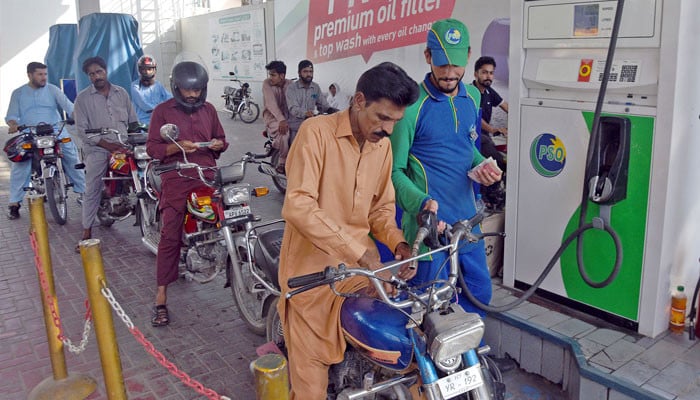
The man filling a motorcycle tank on the Murree Road does not experience any of this as a mechanism. He experiences Rs342.02.
The next build-up will appear on Ogra’s site, probably tomorrow. I will read it, and it will tell us about last week.
—
Aflatoon is a satirist and observer of the Pakistani condition. His column, Intellectual Voices, appears in The Pakistan Daily.