
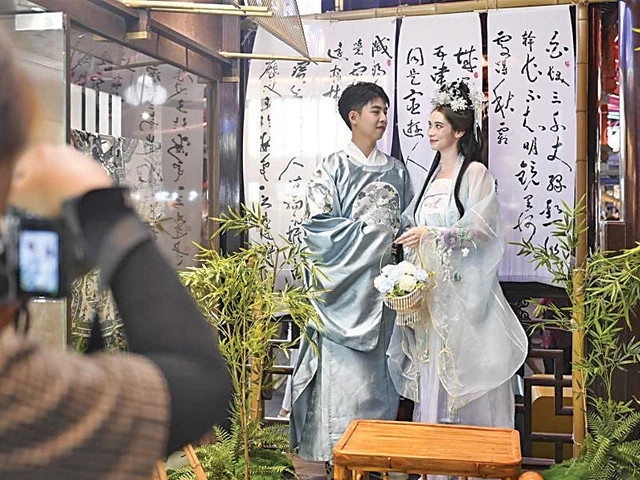
Foreign visitors are embracing traditional dress as social media fuels the cultural wave
BEIJING:
With the number of foreign tourists increasing across China, the sight of international visitors dressed in Hanfu, a form of traditional Chinese clothing, in scenic locations has become an increasingly striking cultural moment.
In the moat of Beijing’s Forbidden City—the 600-year-old complex that once served as an imperial palace—Jessica Savano, a travel content creator from the United States, donned a palm crown, carried a round silk fan and posed in richly embroidered attire against red walls and yellow tiles.
“This is a must do if you ever come to China. I will have these photos forever. How incredible,” Savano said in her vlog. Like her, many foreigners are embracing this immersive way of engaging with Chinese culture and sharing their images on social media.
By June, the #Hanfu hashtag on TikTok had amassed nearly 300,000 videos, fueling global interest in traditional Chinese fashion. In one such video, an international student from South Africa showcased her ancient-style photography in Chengdu.
“I feel like the female lead in a Chinese TV drama,” she said, garnering nearly 40,000 likes. Elsewhere on TikTok, influencers joked: “Unfortunately, I’ll never feel beautiful again because this was my photoshoot in China,” a humorous way of expressing how these elaborate shots often feel like a prime beauty moment.
The comments on these videos are full of praise from the global audience, who admire the outfits, hairstyles and overall aesthetic. Many users confessed that they felt inspired to travel, writing: “I wish I could go to China for a photo shoot too!”
Adjacent to the Forbidden City, Wangfu Century Plaza has become a major stop for visitors looking for traditional costumes, make-up and hairdressing services. The building houses hundreds of studios offering these experiences, including one run by Kai Wen (pseudonym). His studio has around 400 sets of traditional clothing covering styles from various dynasties.
“Since the beginning of 2025, we have served nearly 70 groups of foreign tourists. Compared to last year, there was an increase of about 20 percent,” he said, adding that visitors ranged from toddlers to people in their 70s. “Most people find it a new and enjoyable experience when they try on these clothes.”
For many tourists, China’s cultural wealth plays a central role in this growing trend. “Traveling abroad is largely an experience of foreign cultures and a form of cultural consumption, and clothing is an important external expression and carrier of a country or region’s culture,” said Zhang Jinshan, a researcher at Peking University.
A feature published by the Shanghai-based Youth Daily noted that foreign visitors today choose traditional clothing not just out of curiosity but out of genuine appreciation. He noted that Chinese clothing has evolved over millennia into an aesthetic system that is diverse yet cohesive, offering options suitable for different backgrounds and tastes, thus broadening its appeal.
This cultural engagement is also supported by a surge in global travel to China, spurred by the expansion of visa-free policies. China now has reciprocal visa-waiver agreements with 29 countries and unilateral visa-free access for nationals of 48 others, covering areas such as Europe, Latin America and the Middle East.
As of November 23, Beijing’s ports had recorded 5.78 million inbound and outbound trips by foreign nationals, up 35% year-on-year. About 60% of inbound travelers benefited from visa-free or temporary entry policies.
In the third quarter, foreign nationals made 7.25 million visits under visa-free programs, a year-over-year increase of 48.3 percent and accounting for 72.2 percent of all overseas arrivals, according to the National Immigration Administration.
With these growing arrivals, more visitors are exploring traditional dress experiences and cultural activities, enriching their travels and expanding consumption opportunities. This trend, Zhang said, is contributing to an increase in the overall level of tourism spending in China.
a href=”https://tribune.com.pk/story/2580220/hanfu-fever-sweeps-chinas-tourist-trail”>Source link



