
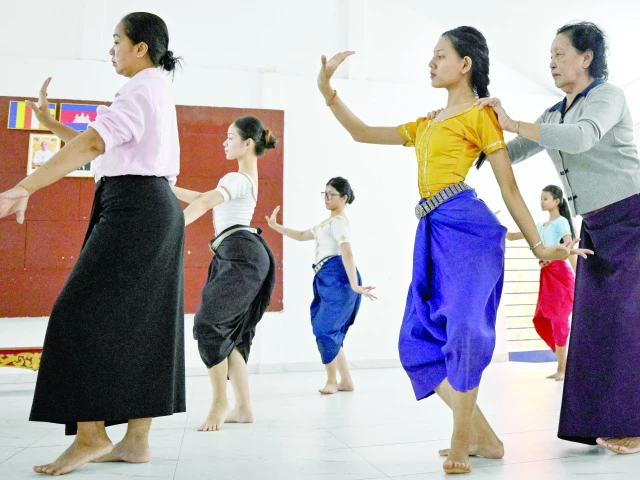
Education of student teachers in Secondary Fine Arts Education. Photo: AFP
PNM PENH:
Cambodian master classical dancer Penh Yom moves among her teenage students, carefully adjusting a bent toe here and a head tilt there, as she goes through a centuries-old art form.
Classical Khmer dance, performed to traditional music, is known for its graceful gestures and elaborate costumes, and has a history spanning a millennium. But after barely surviving Cambodia’s genocidal Khmer Rouge regime in the 1970s, the tradition now faces new threats.
Due to the changing media and entertainment landscape, limited funding and financial pressures, enrollment at the Phnom Penh Secondary School of Fine Arts is declining and many students do not complete the grueling nine-year curriculum.
The art form nearly disappeared when the Khmer Rouge killed nearly all the top dancers and musicians, among nearly two million who were murdered or died of starvation, disease or overwork during the regime’s brief four-year rule.
Pol Pot’s followers saw the dancers as enemies of the people, both educated and symbolic of a feudal past they were trying to erase. Artists were specifically targeted for identification and elimination. Penh Yom, 78, survived by hiding her profession. After the fall of the Khmer Rouge-ruled Democratic Kampuchea in 1979, he regrouped with a small troupe of dancers to revive the form. Her own education began at the Royal Palace when she was only eight.
“Now I’m worried it’s going to disappear,” he said. “We keep urging them to train hard and help us preserve this art. Like ‘you the grandkids and me the grandma, try hard together.’
Dancer Yang Sopheaktra, 21, who graduated three years ago, recalled that the training was “really difficult”. “We need patience. For example, when we bend our fingers, we have to count to 100,” he said. “We have to remember many dance styles. Students with less talent often give up easily. Sometimes I was so tired I wanted to give up.”
Her father, also a dancer, had initially opposed her following in his footsteps. “He wanted me to learn everything that wasn’t related to the arts.” But he insisted: “I want to help preserve this art form with new ideas.”
From hair to nails
Also known as the Royal Ballet of Cambodia, classical dance performances were originally staged for court occasions such as coronations or weddings. The art form was first introduced to an international audience in colonial France in 1906.
UNESCO declared it an intangible cultural heritage in 2003, noting that it takes “years of intensive training” for dancers to master gestures and poses that “evoke the gamut of human emotions, from fear and rage to love and joy.” However, it risks “becoming a mere tourist attraction”, warns UNESCO.
The Secondary School of Fine Arts employs more than 90 classical dance teachers and serves as the primary training center for the next generation. Students attend dance classes in the mornings and follow the standard school schedule in the afternoons.
Tuition is free, but accommodation has been reduced and educators expect many students to drop out amid educational demands and family financial pressures. This year, 39 eight-year-olds signed up, just over half the usual number.
A few weeks into the lesson, the newcomers flexed their arms, legs and bodies under the watchful eye of instructor Hang Sophea, who focused on instilling the basics. “I have to watch them from head to toe so that in the future they will be our heirs,” he said.
Some students will drop out soon and a maximum of 15 are expected to complete the training. “As teachers, we are worried… Now is the modern age and everything is on a smartphone,” added Hang Sophea. “We constantly remind them not to forget our identity.”
But some students are embracing social media to promote their art. Tola Thina, 18, in her senior year, often posts her looks on Facebook, where she has over 20,000 followers. “This culture is really beautiful and I love it,” he said. “I want to be a traditional dancer and keep it.”
a href=”https://tribune.com.pk/story/2584892/grace-under-pressure”>Source link



