
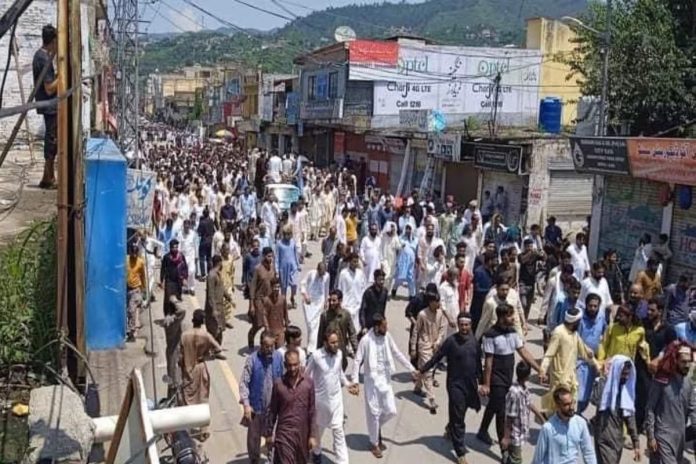
The Joint Awami Action Committee is marching on Muzaffarabad today. Security forces are at the checkpoints. Twenty-eight people are dead. The AJK election is in twelve days.
The question this raises is a structural one, not a tactical one: what does a protest movement do in the twelve days before a vote?
Street politics and electoral politics operate on different logics. Street politics is about the cost you can impose on a government — through disruption, through public spectacle, through the sustained capacity to bring bodies to a march even when the government has reinforced the roads in. Its leverage depends on the threat of escalation. A movement that cannot escalate further loses its primary instrument. Electoral politics is about converting diffuse grievance into organised votes — which requires a different kind of infrastructure, different timing, and a readiness to accept partial outcomes in exchange for institutional representation.
The JAAC has been navigating this tension since it first emerged in 2022. Its demands — lower electricity tariffs, subsidised flour at Gilgit-Baltistan rates, elimination of reserved seats for diaspora Kashmiris — are concrete, material and directly verifiable. These are not abstract political positions; they are things that either happen or do not happen in the space of a budget cycle. This specificity is the movement’s strength. It is also the reason the government’s ability to simply wait out the protests without conceding anything real is limited: the demands are simple enough that partial compliance is visible, and simple enough that total refusal is also visible.
The July 15 march complicates this. A march on the capital twelve days before an election is a statement — to voters, to the government, to candidates — that the movement’s street capacity is still live. It is a way of saying: we have not been absorbed into the electoral process. We have not traded the march for a manifesto. Whatever happens at the ballot, we remain capable of this.
What the government does at the checkpoints today will communicate something to those voters in both directions. If security forces block the march aggressively and there is violence, that violence will land in the twelve-day campaign period with no insulating distance. If the march proceeds without incident, it demonstrates a movement that the government chose not to confront directly — which is its own kind of signal about who has leverage.
The JAAC is not running as a unified electoral bloc. Individual candidates from its affiliates are contesting, but the committee itself is not a party in the conventional sense. This means its political translation problem is real: protest capacity and electoral organisation are different things, and the movement that can fill the streets on July 15 may or may not be able to convert that energy into the specific distributed work of winning constituencies on July 27.
The demands remain unmet. The marchers are on the road. The election is in twelve days.
What happens in that interval will determine whether this is a movement that shapes an election, or an election that absorbs a movement. The two outcomes are not the same, and from the checkpoints in Muzaffarabad this morning, it is still not clear which one it will be.



