
By Aflatoon
Two things are happening today and I would like to place them side by side, because nobody else is going to.
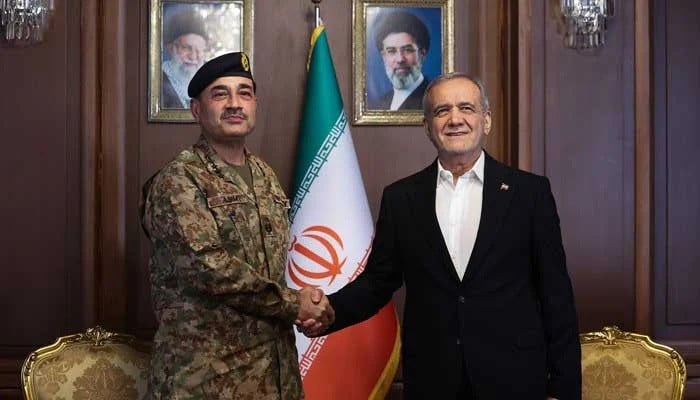
The Chief of Defence Forces is in Tehran.
And Jamaat-e-Islami is preparing to close every shop in the country on the price of diesel.
These are the same story. I will try to show you why.
—
Start with what the man is carrying. A government source listed it for Reuters, and the list is remarkable for how much is in it.
He will discuss peace under Islamabad’s memorandum. He will discuss Trump’s warning about countries that give Iran a lifeline. He will discuss the situation after the Pakistan-Turkiye-Saudi agreement. He will discuss the Houthis.
Four items. Consider what each one actually means.
We are mediating between the United States and Iran — genuinely, not decoratively; we brokered the April ceasefire and we have been carrying messages since. We are also, since the seventh of this month, bound by treaty to treat an attack on Saudi Arabia as an attack on ourselves. And we are being warned by Washington not to be a lifeline to the country we are mediating for.
A man is being sent to a capital to say, in effect: we are your friend, we are allied with your rivals, we are relaying the demands of your enemy, and we would like you to reopen the strait.
I do not say this to mock. It may be the most useful diplomatic position anyone in the region currently occupies, precisely because nobody else can hold all four things at once. But let us not pretend it is comfortable.
—
Now the second thing.
Hafiz Naeem stood in Lahore on Sunday and said the sit-ins would become a nationwide shutter-down after the twenty-sixth. He said something more interesting too, which is that the protest will no longer end on assurances.
The sit-in will end only when the government implements our demands in practical terms.
Anyone who has watched Pakistani protest politics knows what that sentence closes. The standard resolution is a delegation, a commitment, a photograph, and a dispersal. He has publicly refused the photograph.
His demand is that the petroleum levy go. His complaint is that diesel came down thirty-two rupees last week and the levy did not move a paisa — the refineries paid, the treasury did not. I have written that column. He is right.
—
Here is the join.
Why is diesel at three hundred and sixty-eight rupees? Because crude is above ninety-one dollars. Why is crude above ninety-one dollars? Because oil traffic through the Strait of Hormuz is at a standstill and Iran has just promised that not a drop will flow if the economic war continues.
Why is there an economic war? Because at six o’clock this evening, Greenwich time, an American treasury secretary will stand up and announce the greatest financial offensive ever marshalled against Iran.
And who is in Tehran today, trying to talk somebody out of something?
The refinery arrangement that cut our diesel price was explicitly written to last until the situation in the Strait of Hormuz improves. That is not a metaphor. That is a clause. Four Karachi refineries are absorbing a loss on every litre, on a contract whose end date is being negotiated today, by a field marshal, in a foreign capital.
—
I want to be fair to the government, which is not my usual instinct.
There is nothing they can do about the price of crude. Nothing. A country importing almost all of its oil, in a war it did not start, in a strait it does not control, has approximately no levers. Blaming Islamabad for ninety-one dollars is like blaming the barometer.
And the mediation is real. The April ceasefire held for a fortnight, which in that conflict counts as an achievement.
But observe what the government does control, and has not touched. It collects a hundred rupees a litre on diesel and a hundred and fourteen on petrol. When it wanted to deliver relief, it did not reduce that. It convened four private companies and asked them to reduce theirs.
So: the part we cannot control is genuinely uncontrollable, and the part we can control has been carefully left alone. This is not a coincidence. It is a preference.
—
There is a version of this column that says the shutter-down is irresponsible while the Field Marshal is doing delicate work abroad. That the country should not be shut on the day we are being useful to the world.
I do not believe it. The shopkeeper in Faisalabad closing his shutter on the twenty-seventh is not undermining the negotiation. He has no view on the Houthis. He has a view on three hundred and sixty-eight rupees, and it is a reasonable one.
What he is owed is not silence. It is the explanation that nobody has offered him: that his fuel price is set in a strait two thousand kilometres away, that his government is genuinely trying to help unblock it, and that in the meantime the largest single item in the price he pays is a tax his own state has chosen not to reduce.
Two of those three facts have been said out loud this week. Guess which one has not.
—
Aflatoon is a satirist and observer of the Pakistani condition. His column, Intellectual Voices, appears in The Pakistan Daily.



