By Aflatoon
Tomorrow the flags go up. There will be a ceremony, and an address, and by evening a great deal of talk about what seventy-nine years have made of us.
I want to put one object beside all of that.
A disposable syringe. It costs a few rupees. It is called disposable because you use it once and throw it away; the whole design intention is contained in the adjective. There is no technique to master, no infrastructure to build, no foreign exchange to arrange. You use it, and then you do not use it again.
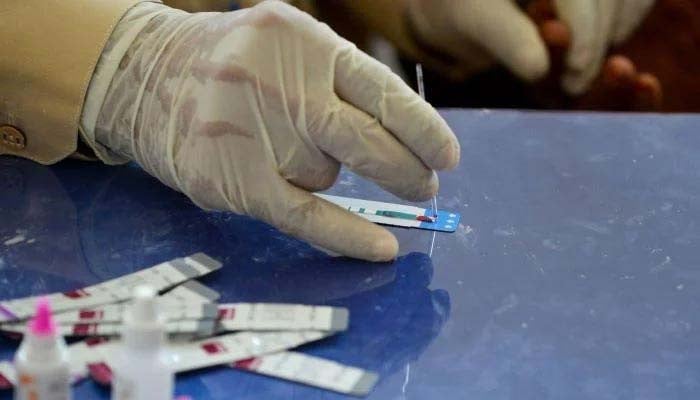
At the Kulsum Bai Valika Hospital in SITE, about one hundred and twenty children have tested positive for HIV.
Nine of them died while the case seeking an independent inquiry sat in court.
—
I want to be careful here, because a petition is a set of allegations and not a finding. The claim before the Sindh High Court is that the outbreak was caused by the reuse of contaminated syringes and by gross negligence. The court has reserved its order. Nothing has been proved.
But I would ask you to hold two facts together and see whether they leave much room.
The first is scale. One infected child at a hospital is a tragedy and possibly an accident. A hundred and twenty is not an accident. A hundred and twenty is a procedure — something done the same way, repeatedly, over a long period, by people who had stopped noticing they were doing it.
The second is that we have been here before. Ratodero, 2019. Hundreds of children in Larkana district. Investigations pointed at unsafe injections and reused equipment. It was national news. There were inquiries and commitments and a great deal of appropriate horror.
Seven years later, the same mechanism, in a different district, in a hospital run by the state.
—
Consider what kind of hospital this is.
The Sindh Employees’ Social Security Institution exists to provide medical cover to registered workers and their dependants. It is funded by contributions from employers on behalf of their staff. It is, in the narrow technical sense, the closest thing a Pakistani labourer has to a right to healthcare.
So these were not children whose parents were careless. These were children whose parents were formally employed, in the documented economy, contributing through a registered employer to an institution created for exactly this purpose.
They did the thing we are always telling people to do. They were inside the system. The system was the exposure.
—
I have been writing all week about institutions that do not work — a crime scene left unpreserved for nine days, a post-mortem so poor the officer who conducted it has now been removed, a family that had to obtain a court order to have their son’s body properly examined.
I notice that all of these failures share a quality. None of them required money.
Preserving a crime scene requires tape and a constable. Conducting an X-ray during a post-mortem requires a machine the hospital already owns. Using a new syringe requires a new syringe.
We are not, in these cases, a poor country failing to afford things. We are a country in which the cheap and obvious step was available, and known, and skipped — and in which nobody expected to be asked about it afterwards.
That last clause is the whole disease. The syringe is a symptom.
—
Tomorrow somebody will say, from a podium, that Pakistan was created so that its people could live with dignity.
I believe that is true, and I do not say it cynically. It is the claim the country makes about itself, and it is a good claim, and seventy-nine years is not very long.
But dignity is not principally a matter of anthems. For a working man in SITE it means that when he takes his child to the hospital his contributions pay for, the needle is new.
Nine families in Karachi did not get that. They will watch the flags go up tomorrow the same as everyone else.
—
I do not have a policy proposal to end on, because the policy already exists. Single-use means single-use. It is written down. It is taught. It is not contested by anybody.
Something has begun to move, and I record it in fairness. The High Court has now ordered the chief secretary to constitute an empowered committee. Two doctors and seventeen nurses have been suspended; thirty-seven more have show-cause notices. Forty-four HIV treatment centres have been set up across the province.
I note also what the court asked that committee to establish. Not only how the infections happened — but how many children there actually are. Seven years after Ratodero, at a hospital run by the state, we are still at the stage of counting.
So my request for the seventy-ninth Independence Day is narrower than a reform, and I am aware of how small it sounds.
Finish the counting. Then find out who reused them, and say the names out loud — not the nurses alone, who are the easiest people in any hospital to suspend, but whoever decided the supply of syringes need not match the number of injections. Do it before the anniversary of Ratodero comes round again, and before there is a third district, and a third set of parents being told that an inquiry has been constituted.
A country that cannot guarantee a clean needle has not run out of money.
It has run out of the expectation that anyone will ask.
—
Aflatoon is a satirist and observer of the Pakistani condition. His column, Intellectual Voices, appears in The Pakistan Daily.