
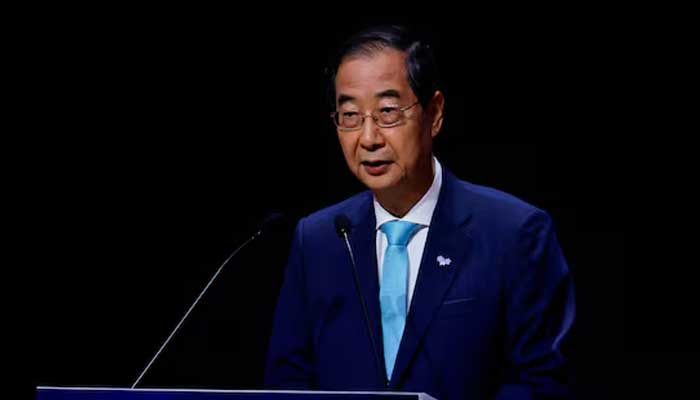
SEOUL: South Korean Prime Minister Han Dak-soo became the country’s acting president after parliament voted to impeach President Yoon Suk-yeol on Saturday.
With the parliament’s impeachment vote against Yun passed after his short-lived attempt to impose martial law, Yun is suspended from exercising presidential powers and the Constitution requires the prime minister to assume acting duties.
PM Han is a career technocrat whose broad experience and reputation for rationality could serve him well in his latest role.
In a country sharply divided by partisan rhetoric, there was a rare official whose varied career crossed party lines.
The acting president faces a difficult task of keeping the government running through the worst political crisis in four decades, while facing threats from nuclear-armed North Korea and a slowing economy at home.
His tenure could also be threatened by criminal investigations into his role in the martial law decision.
Average, reasonable
Hahn, 75, has served in leadership positions for more than three decades under five different presidents, conservatives and liberals
His roles include Ambassador to the United States, Secretary of the Treasury, Secretary of Commerce, Presidential Secretary for Policy Coordination, Prime Minister, Ambassador to the OECD, and head of various think-tanks and organizations.
With a PhD in economics from Harvard, Han’s expertise in economics, trade and diplomacy, as well as his reputation for rationality, modesty and hard work, have made him a regular in South Korean politics.
“He has served in key positions in state affairs only through the recognition of his skills and expertise, which are not related to political factions,” Yun said when he appointed Han in 2022, repeating words that described him when previous governments chose him for key positions.
“I think Khan is the right candidate to handle national affairs while overseeing and coordinating the cabinet, with a wealth of experience spanning the public and private sectors,” he added.
Hahn has experience working with South Korea’s key ally, the United States, having been deeply involved in the signing process of the US-South Korea Free Trade Agreement.
Fluent in English, he was appointed South Korea’s ambassador to the US in 2009, worked in Washington when current US President Joe Biden was vice president, and helped Congress approve the Free Trade Agreement in 2011.
Khan has also served as a board member of S-Oil — a South Korean refining unit of Saudi Aramco.
His leadership role is expected to last for months until the Constitutional Court decides whether to remove Yoon or restore his powers. If Yun steps down, a presidential election would have to be held in 60 days, until Han remains at the helm.
The main opposition Democratic Party filed a complaint against Khan to be included in the investigations for failing to block Yun’s attempt to impose martial law.
If parliament decides to impeach Khan, the finance minister is next in line among cabinet members to serve as acting president.
South Korea’s Constitution does not specify how much power the prime minister has to exercise the leadership role.
a href=”https://www.geo.tv/latest/579582-who-is-han-duck-soo-south-koreas-pm-and-acting-president-after-yoons-impeachment”>Source link



