
Like other Asian countries, Pakistan is going through a climate crisis due to which summers become brutal and winters become milder with each passing year.
The Lancet reports that due to rising temperatures, there has been an outbreak of many arboviral diseases in the region as well as in Pakistan, including malaria, dengue and now Chikungunya.
Against this backdrop, Karachi has been witnessing a rise in Chikungunya cases since at least May this year, with hospitals in the metropolis reporting suspected patients of the virus daily.
What exactly is the disease and how quickly is it spreading among the residents of Pakistan’s largest city?
What is Chikungunya virus and how is it transmitted?
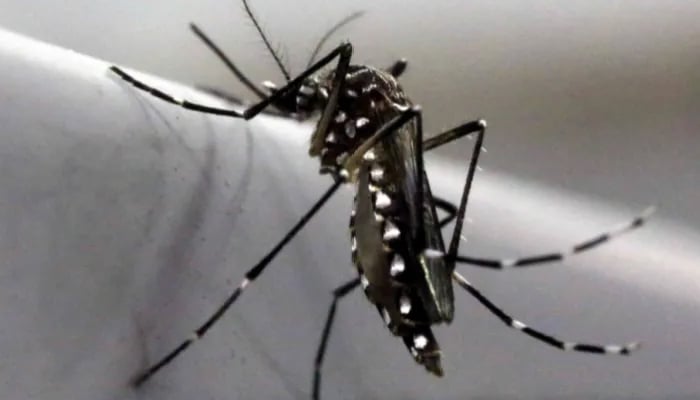
Chikungunya is a mosquito-borne viral disease transmitted through the bite of infected “Aedes aegypti mosquitoes” and “Aedes albopictus mosquitoes,” according to the Cleveland Clinic..
If a mosquito carrying the virus bites a person, the virus is transmitted to that person.
But if an uninfected mosquito bites an infected person, it acts as a carrier of the virus by absorbing it from that person’s bloodstream and transmitting it to others through bites.
Al Jazeera reports that according to health authorities, the risk of Chikungunya spreading through a vector mosquito is highest in the first week after infection.
These mosquitoes also carry and spread dengue fever and Zika virus.
How serious is the outbreak in Karachi?
A spokesman for the Sindh Health Department said that this year, from May to September, 172 positive cases of Chikungunya were reported in Karachi, while 956 suspected cases of the viral disease were reported. Of the 956 suspects, 713 were examined.
A report from the Aga Khan University Hospital revealed that Chikungunya is particularly reported among the elderly and diabetic patients.
Symptoms of the disease
According to the Centers for Disease Control and Prevention, Chikungunya virus symptoms begin 3-7 days after the virus is transmitted to the human body.
The most common signs of the disease are fever and joint pain while other symptoms include headache, muscle pain, joint swelling and body rash.
CDC adds that people with Chikungunya feel better within a week of infection, however, joint pain can be severe and can continue for months.
Rashes from the virus appear within the first 2-3 days of infection and last about 7-10 days. These rashes are usually red and may be flat or look like raised bumps on the face, trunk, and limbs, and may occasionally itch, according to a report by AKU Hospital.
According to the World Health Organization (WHO), the symptoms of Chikungunya are similar to those of dengue fever and Zika virus, which makes it often misdiagnosed as the other two diseases.
Is there a vaccine to prevent Chikungunya?
A single-dose vaccine, IXCHIQ, is available in the United States and is approved for people 18 years of age and older, according to a 2023 US Food and Drug Administration (FDA) article.
However, a spokesman for the Sindh Health Department cited Al Jazeera saying that Pakistan only administers vaccines approved by the WHO, which has not approved any vaccine for Chikungunya so far.
a href=”https://www.geo.tv/latest/571000-what-is-chikungunya-and-why-is-it-spreading-in-karachi”>Source link



