
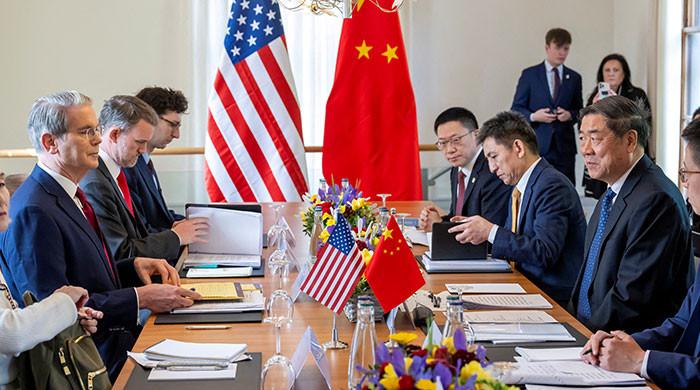

Stockholm: Top officials from the US and China met in Stockholm on Monday for five hours of talk -to -face talks, hoping to cool the tensions and avoid another round of expensive invoices.
The meeting, held at the Swedish Prime Minister’s office, is considered a new attempt to stabilize relations between the world’s two largest economies after months of trade.
US Department of Finance Chief Scott Bessent was part of an American negotiating team that arrived at Rosenbad, the Swedish Prime Minister’s office in Central Stockholm, early in the afternoon. China’s vice president, China’s Lifeng, was also observed in the video area.
China is facing a deadline of August 12 to reach a durable duty agreement with President Donald Trump’s administration, as Beijing and Washington reached preliminary agreements in May and June to end weeks of escalating invoices and invoices.
The negotiators on both sides were observed to leave the office around 8 pm (1800 GMT) and did not stop talking to journalists. The discussions are expected to be repeated on Tuesday.
Trump touched talks during a broad press conference with British Prime Minister Keir Starmer in Scotland.
“I would love to see China open their country,” Trump said.
Without agreement, global supply chains could face refreshed unrest from US duties returning to a triple -digit that would equate bilateral trading embargo.
US trading spokesman Jamieson Greer said he did not expect “some huge discovery today” in the talks in Stockholm.
“What I expect is to continue monitoring and checking the implementation of our agreement so far, ensuring that basic critical minerals are flowing between the parties and the determination of basic work for enhanced trade and a balanced trade forward.” Cnbc.
Stockholm’s talks follow Trump’s largest trade agreement, but also with the European Union, announced on Sunday, which includes a 15% invoice to most EU exports to the United States.
XI-Trump meeting?
Commercial analysts said another 90 -day extension of an invoice and export control of exports, hit in mid -May between China and the United States, was likely.
An extension would facilitate planning for a possible meeting between Trump and Chinese President Xi Jinping, scheduled for October or at the beginning of November.
The Financial Times reported on Monday that the US had stopped margins to technology exports to China to avoid disorder of trade talks with Beijing and support Trump’s efforts to secure a meeting with XI this year.
Meanwhile, in Washington, US senators are planning to enter accounts this week with the aim of treating minority groups, dissidents and Taiwan, highlighting security and human rights, which could complicate the talks.
Taiwan President Lai Ching-Te will delay a August trip that his team had floated in the Trump administration that would include stops in the United States, according to sources familiar with the issue, he told Reuters on Monday.
The possible visit would have angry with Beijing, possibly derailing the commercial conversations. China claims that Taiwan as its own territory, a position rejected by Taiwan and denounces any demonstration of Taipei support from the United States.
The previous US-China commercial talks in Geneva and London in May and June focused on attracting Chinese retaliation from triple digits and restoration of the flow of mineral rare earths stopped by China and NVDA.
So far, talks have not been transferred to broader financial issues. These include US complaints that the export -based Chinese model are floods in global markets with cheap goods and Beijing’s complaints that US export exports to technological goods seek to immobilize Chinese growth.
“Geneva and London were really to try to get the relationship back on the street so that they can, at some point, negotiate to really negotiate on issues that bring to life the disagreement between countries in the first place,” said Scott Kennedy, an expert in China financially at the Strategic and International Strategy Center.
Bessent has already highlighted an extension of the deadline and said that it wants China to balance its economy away from exports to more domestic consumption for decades for policymakers.
Analysts say US-China negotiations are much more complicated than those with other Asian countries and will take longer. China’s handle on the world market for minerals and magnets of rare land, used in everything, from military material to Windscreen Wiper Motors highways, proved to be an effective leverage in US industries.
a href=”https://www.geo.tv/latest/616238-us-china-make-trade-progress-paving-way-for-possible-trump-xi-summit”>Source link



