
ASEAN talks seek compromise after Trump’s tariff threats and China’s new rare earth export limits
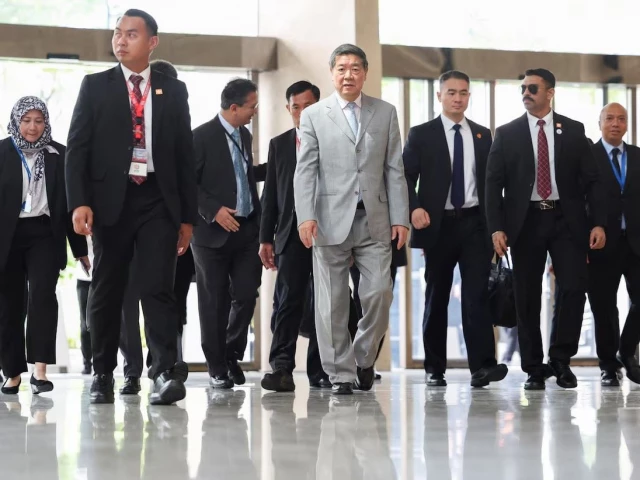
Chinese Vice Premier He Lifeng arrives for trade talks between the United States and China, in Kuala Lumpur, Malaysia, October 25, 2025. PHOTO: REUTERS
Top economic officials from the US and China wrapped up the first day of talks in Kuala Lumpur on Saturday, with a finance ministry spokesman describing them as “very constructive”.
The world’s two largest economies are scrambling to prevent an escalation in their trade war and ensure a meeting between US President Donald Trump and Chinese President Xi Jinping takes place next week.
The talks on the sidelines of the Association of Southeast Asian Nations summit will chart a way forward after Trump threatened new 100 percent tariffs on Chinese goods and other trade restrictions from Nov. 1 in retaliation for China’s greatly expanded export controls on magnets and rare earth minerals.
Read more: Six dead in US strike on suspected Venezuelan drug boat in Caribbean
The recent actions, which also include an expanded US export blacklist covering thousands more Chinese companies, have disrupted a delicate trade truce created by the US. Treasury Secretary Scott Bessent, US Trade Representative Jamieson Greer and China’s Vice President He Lifeng in four previous meetings since May.
He smiled and waved to reporters but made no comment as the Chinese delegation left the venue for the talks, Kuala Lumpur’s Merdeka Tower 118, the world’s second-tallest building.
China’s top trade negotiator Li Chenggang is also participating in the talks. A Reuters witness saw Lee arrive at his side earlier in the day.
Of the talks, a Treasury spokesman said: “They were very constructive and we expect them to resume in the morning.”
The Malaysian government and the US and Chinese sides have provided few details about the meeting or any plans to brief the media about the results.
Talking points
The three officials will try to pave the way for Trump and Xi to meet next Thursday at the Asia-Pacific Economic Cooperation summit in South Korea, a high-stakes discussion that could revolve around some temporary relief from U.S. tariffs, technology controls and Chinese purchases of soybeans.
Minutes before the talks began, Trump left Washington for his tour of Asia and raised several talking points for the meeting with Xi.
He said farmers, hit by the freeze on Chinese soybean purchases in the US, and the democratic island of Taiwan, which China claims as its own territory, would be on the list of issues to be discussed. Trump added that he has no plans to visit Taiwan.
He also pointed to the release of jailed Hong Kong media mogul Jimmy Lai, whose case has become the most publicized example of China’s crackdown on rights and freedoms in the Asian financial hub.
“We have a lot to talk to President Xi and he has a lot to talk to us about. I think we’re going to have a good meeting,” Trump said.
Trump left Washington on Friday night for a five-day trip to Malaysia, Japan and South Korea, his first to the region and his longest trip abroad since taking office in January.
On Air Force One, he told reporters that he would also like China to help Washington in its dealings with Russia.
Fine balance
Josh Lipsky, president of international economics at the Atlantic Council in Washington, said Bessent, Greer and He must first find a way to ease their disagreement over U.S. technology export restrictions and China’s rare earth controls, which Washington wants to overturn.
Read also: China’s new five-year plan sharpens industry and technology as US tensions rise
“I’m not sure the Chinese can agree to that. It’s the main leverage they have,” Lipsky said.
Some of those announcements may fall on Trump, who is due to arrive in the Malaysian capital on Sunday.
“We won’t know whether Beijing successfully countered the US export controls with its own restrictions or whether they caused the continuation of an escalating spiral until Trump and Xi meet,” said Scott Kennedy, China economist at the Center for Strategic and International Studies in Washington.
“If they make a deal, their game will have paid off. If there is no deal, then everyone should prepare for things to get a lot worse.”
Rare earth strangulation
The world’s two largest economies are seeking to avoid a return to triple-digit tariff hikes on both sides.
Bessent and Greer’s first meeting with He in Geneva in May led to a 90-day truce that sharply reduced tariffs to about 55% on the US side and 30% on the Chinese side and restarted the flow of magnets. It was extended to further talks in London and Stockholm and was due to expire on 10 November.
But the delicate truce broke down in late September when the US Commerce Department greatly expanded its export blacklist to automatically include companies that are more than 50% owned by companies already on the list, barring US exports to thousands more Chinese companies.
China hit back with new global export controls on rare earths on October 10, aimed at preventing their use in military systems.
Bessent and Greer slammed China’s move as a “global supply chain power grab” and vowed that the US and its allies would not accept the restrictions. Reuters reported that the Trump administration is considering a plan to ratchet up restrictions on a dizzying array of software exports to China, from laptops to jet engines.
The Trump administration added to the tension on Friday by announcing a new tariff probe into China’s “apparent failure” to meet the terms of the 2020 US-China “Phase One” trade deal that ended their trade war during Trump’s first term.
a href=”https://tribune.com.pk/story/2574163/us-china-race-to-ease-tensions-ahead-of-trump-xi-malaysia-talks”>Source link



