
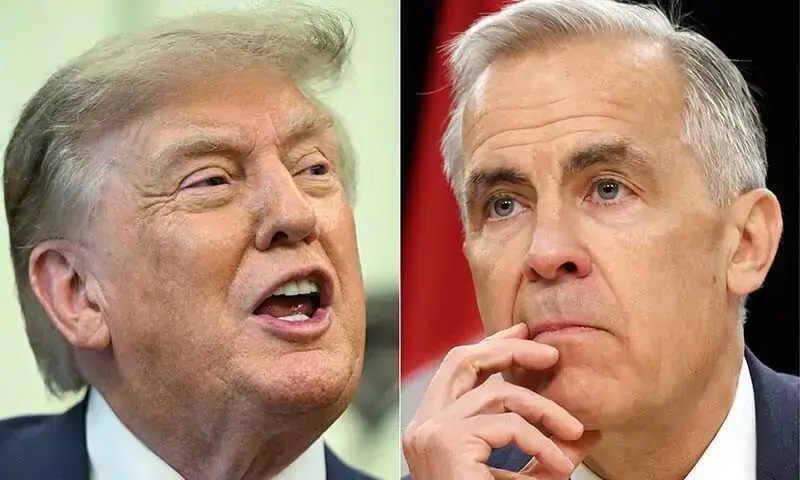
President Donald Trump has signed executive orders banning Canadian alcohol imports and widening tariffs, a day after Canadian retaliation took effect (Dawn).
The measures
| Measure | From | |—|—| | Ban on Canadian alcoholic beverages and some dairy, including whey | 29 September | | 50pc tariffs on mattresses, motorboats, golf carts and other goods | 15 September | | Canadian products removed from GSA federal purchasing schedules | immediate |
The General Services Administration schedules account for more than $50 billion a year — a figure that dwarfs the tariff measures either side has announced.
Trump said he was directing officials “to remove Canadian-origin products from GSA’s Multiple Award Schedules.”
Canada’s answer
Prime Minister Mark Carney said Canada has “everything we need to pivot and prosper”, while acknowledging the cost: “That pivot will come at a cost. There’s always a cost to action. But it doesn’t come close to the cost of standing still.”
Ottawa unveiled a $5.4 billion support package for affected businesses and workers. Trade minister Dominic LeBlanc said the government was “assessing the latest tariff measures”.
What has changed since yesterday
This newspaper reported Canada’s retaliatory duties on $20bn of US goods, at rates of 15 to 50 percent, as they came into force this week. Within a day the United States has responded with an outright import ban and a procurement exclusion.
That is a shift in kind, not degree. A tariff raises a price and leaves the trade legal; a ban ends it, and a procurement exclusion removes a buyer that tariffs never touched.
The asymmetry, restated
We noted yesterday that matching $20bn with $20bn is symmetric in dollars and asymmetric in consequence, because the United States takes roughly three-quarters of Canadian exports. Today’s measures make the point without needing the argument: the GSA line alone is more than twice the value of everything either side has tariffed.
What is not established
No implementation detail has been published for how the alcohol ban treats goods already in transit or in bonded warehouses, and there is still no indication that talks have resumed.
[Image: AFP/File via Dawn]



