

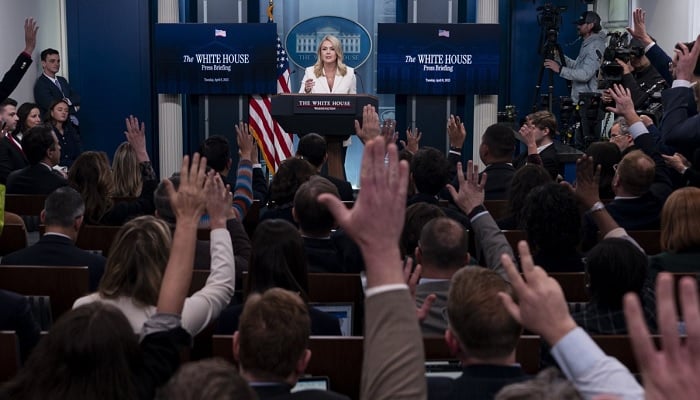
- Journalists will need an appointment to see the press secretary.
- The move follows a crackdown on press access to the Pentagon.
- The new rule takes effect immediately.
A new White House rule issued Friday restricts the ability of accredited reporters to freely access the offices of press secretary Karoline Leavitt and other top communications officials in the West Wing, near the Oval Office.
The new memo from the National Security Council bars journalists from entering Room 140, also known as the “Upper Press,” without an appointment, citing the need to protect potentially sensitive material. He said the change would take effect immediately.
The White House move follows restrictions placed earlier this month on reporters at the Defense Department, a move that prompted dozens of reporters to leave their Pentagon offices and return their credentials.
The National Security Council said the change was made to protect sensitive material now routinely handled by White House communications officials as a result of changes to the council.
“To protect such material and maintain coordination between National Security Council staff and the White House Communications Staff, members of the press are no longer permitted access to Room 140 without prior approval in the form of an appointment with an authorized White House staff member,” the memo said.
Previously, accredited White House reporters could gain access to Room 140, which is a short hallway from the Oval Office, at short notice to speak with Leavitt, her deputy Steven Cheung and other senior officials.
“Some reporters were caught secretly recording video and audio of our offices, along with photos of sensitive information, without permission,” Cheung wrote in a post on X, adding that some reporters wandered into restricted areas or eavesdropped on private, closed-door meetings.
“Cabinet secretaries regularly enter our office for private meetings, only to be ambushed by journalists waiting outside our doors,” Cheung wrote.
Reporters can still access another area where lower-level White House officials have offices, the council memo said.
The White House Correspondents Association, which represents journalists who cover the White House, said the new restrictions would hinder journalists’ ability to question officials, ensure transparency and hold the government accountable.
“The White House Correspondents’ Association strongly opposes any attempt to restrict reporters from areas within White House communications operations that have long been open to news gathering, including the press secretary’s office,” said Weijia Jiang, the group’s current president.
Former President Bill Clinton’s administration announced a similar step in 1993, but later rescinded the measures after a firestorm of criticism.
The Trump administration months ago removed Reuters, the Associated Press and Bloomberg News from its permanent pool of reporters covering the president, although it allows those outlets to participate on a sporadic basis.
Friday’s announcement comes weeks after the Defense Department cracked down on press access, which now requires news outlets to sign a new policy or lose access to press credentials and Pentagon workplaces.
At least 30 news organizations, including Reuters, have refused to agree to the Pentagon restrictions, citing a threat to press freedoms and their ability to conduct independent news gathering.
Pentagon policy requires reporters to acknowledge the new rules on press access, including that they could be labeled security risks and have their Pentagon press badges revoked if they ask department officials to disclose classified and certain types of unclassified information.
a href=”https://www.geo.tv/latest/631549-white-house-tightens-press-access-around-senior-communications-aides”>Source link



