

WASHINGTON: US Supreme Court justices on Wednesday cast doubt on the legality of President Donald Trump’s sweeping tariffs in a case with ramifications for the global economy that marks a major test of Trump’s powers.
Conservative and liberal justices fiercely challenged the attorney representing the Trump administration on whether a 1977 law intended for use in national emergencies gave Trump the power he claimed to impose tariffs or whether the Republican president had invaded the powers of Congress.
But some of the conservative justices also emphasized the inherent power of presidents in dealings with foreign countries, suggesting the court could be sharply divided on the outcome of the case. The court has a 6-3 conservative majority.
The arguments, which lasted more than 2-1/2 hours, resulted in appeals from the administration after lower courts ruled that Trump’s unprecedented use of the controversial law to impose tariffs exceeded his authority. Businesses affected by the tariffs and 12 US states, most of which are led by Democrats, have challenged the tariffs.
“core power”
Conservative Chief Justice John Roberts told US Solicitor General John Sauer, ruling in favor of the government, that tariffs are “the imposition of taxes on Americans, and that has always been the core power of Congress.”
Tariffs – taxes on imported goods – could add up to trillions of dollars in revenue for the United States over the next decade. The US Constitution gives Congress the power to enact taxes and duties.
Roberts suggested the court could apply the “big questions” doctrine, which requires executive branch actions of enormous economic and political significance to be clearly authorized by Congress.
“Justification is used for the power to impose tariffs on any product, from any country, in any amount, for any length of time. I’m not suggesting it doesn’t exist, but that seems to be the main principle and the basis for that assertion seems to be inappropriate,” Roberts said.
The Supreme Court applied the “big questions” doctrine to strike down key policies of Trump’s Democratic predecessor, Joe Biden.
Trump has lobbied the Supreme Court to uphold the tariffs that he has used as a key economic and foreign policy tool. A ruling against Trump would mark a major departure for the court, which has backed him in a series of rulings temporarily authorizing his sweeping actions in areas as diverse as cracking down on immigration, firing federal service officials and banning transgender troops.
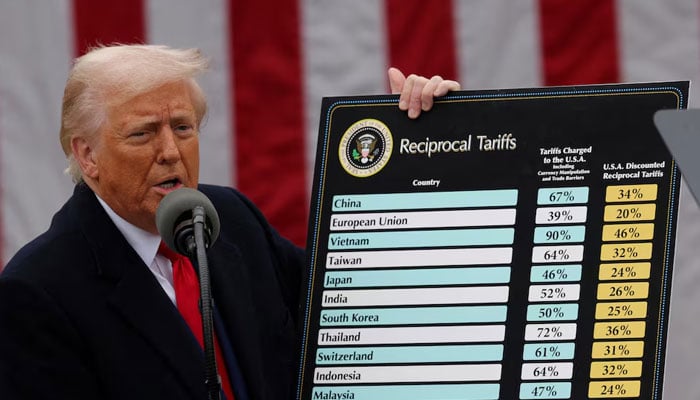
Trump invoked the International Emergency Economic Powers Act, or IEEPA, to impose tariffs on nearly every US trading partner. The law allows a president to regulate commerce in the event of a national emergency. He became the first president to use IEEPA for that purpose, one of the many ways he has pushed the limits of executive power since returning to office in January.
Conservative Justice Amy Coney Barrett questioned Sauer about his contention that IEEPA’s language giving presidents emergency power to regulate imports includes tariffs.
“Can you point to any other place in the code or any other time in history where this phrase together with “regulates importation” has been used to confer the power to impose tariffs?” Barrett asked Sauer.
Liberal Justice Ketanji Brown Jackson said the IEEPA was intended to limit presidential power, not expand it.
“It’s pretty clear that Congress was trying to limit the president’s emergency powers,” Jackson said.
While the Supreme Court typically takes months to rule after hearing arguments, the administration has asked it to act quickly in this case, though the timing of the ruling remains unclear.
US Treasury Secretary Scott Bassett, who attended the hearings on Wednesday, said that if the Supreme Court convicts Trump, the administration will turn to other legal authorities to ensure his tariffs remain in place. Bessent later told the Fox Business Network’s “Kudlow” program that he came away from the arguments “very, very optimistic.”
Trump has imposed some additional tariffs citing other laws. That is not the case here.
“Unscrupulous Trade Retaliation”
The IEEPA gives the president the authority to deal with “an unusual and extraordinary threat” in the midst of a national emergency. Historically it had been used to sanction enemies or freeze their assets.
Sauer said Trump is adamant that US trade deficits have brought the nation to the brink of economic and national security disaster and that the tariffs have helped Trump negotiate trade deals. Abolishing those agreements “would expose us to relentless trade retaliation from far more aggressive countries and drive America from strength to failure with devastating economic and national security consequences,” Sauer said.
Trump instigated a global trade war when he returned to the presidency, alienating trading partners, increasing volatility in financial markets and fueling global economic uncertainty.
He used tariffs to extract concessions and renegotiate trade agreements, and as a cloak to punish countries on non-trade political issues.
Trump invoked the IEEPA to impose tariffs on goods imported from individual countries to address what he called a national emergency related to US trade deficits, as well as in February as economic leverage on China, Canada and Mexico to curb the trafficking of the commonly abused painkiller fentanyl and illegal drugs into the United States.
Doctrine on the main questions
Emphasizing the president’s foreign affairs powers, Sauer told the justices that the “big questions” doctrine should not apply in this context.
Conservative Justice Brett Kavanaugh signaled possible sympathy for Trump, rejecting the argument that Trump had done anything new that could implicate the doctrine. Kavanaugh noted that President Richard Nixon imposed a global tariff under the previous IEEPA statute in the 1970s that contained similar language regarding import regulation.
“That’s a good example for you,” Cavanaugh told Sauer.
The Supreme Court has long shown deference to the president when it comes to conducting foreign policy. Roberts, while questioning a lawyer for the private enterprise’s competitors, Neal Katyal, seized on that point, noting that Trump’s tariffs have undoubtedly given him leverage in striking foreign trade deals.
Tariffs based on the IEEPA generated $89 billion in estimated collections between February 4 and September 23, when the most recent figures were released by US Customs and Border Protection.
“Sure, tariffs are a tax and that’s a core power of Congress, but it’s a foreign-facing tax, right? And foreign affairs is a core power of the executive branch,” Roberts told Katyal.
Questions from conservative Justice Neil Gorsuch indicated he believed Sauer’s claims about the scope of the president’s inherent powers in foreign affairs would threaten to undermine the Constitution’s separation of powers between the executive and legislative branches of the federal government.
“What would prohibit Congress from abdicating all responsibility for regulating foreign trade — or for that matter, declaring war — to the president?” Gorsuch asked.
a href=”https://www.geo.tv/latest/632295-us-supreme-court-casts-doubt-on-legality-of-trumps-global-tariffs”>Source link



