
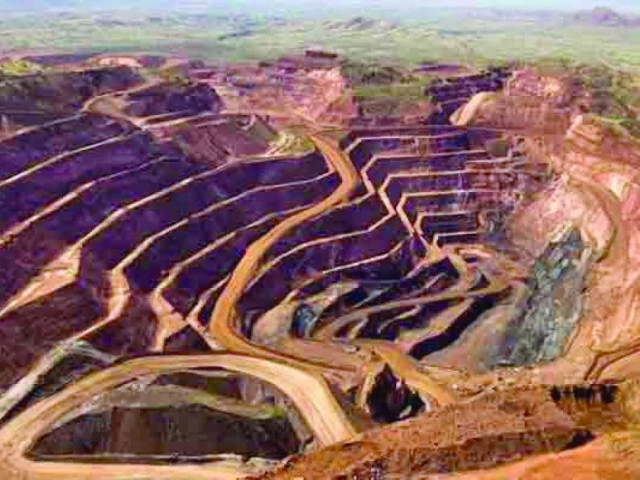
Pakistan has already put forward a $1.9 billion financing plan to execute the Reko Diq copper and gold mining project. The total funding of the project has been estimated at 4.297 billion dollars. Photo: Archive
Islamabad:
Oil Minister Ali Pervaiz Malik said on Thursday that Reko Diq Mining Company was very close to financial closure with $3.5 billion in loans, as the company’s local arm promised to complete the $7 billion first phase of the project in the next three years.
Reko Diq Mining Company is very close to achieving financial closure and raising $3.5 billion in debt, Malik said while talking about the prospects of Pakistan’s mining sector during a seminar organized by the Pakistan Business Council (PBC).
The minister’s statement came days after the board of the US Export-Import Bank (Exim) approved a $1.25 billion loan for the Reko Diq mine, as part of the US Congress’ broader plan to invest $100 billion to secure global mineral supplies.
The total cost of the project is estimated at $7.7 billion, which includes $3.5 billion in debt from 11 international banks and organizations.
Zarar Jamali, Country Manager of Reko Diq Mining Company, said the $3.5 billion financing has been secured by 11 banks, including Japan, Canada and the United States. Jamali said the first export shipment is targeted for the first quarter of 2029.
There were high hopes that Reko Diq miners can solve the problems of Pakistan’s foreign sector. However, the oil minister downplayed claims of $7 trillion worth of mineral reserves in Pakistan, saying “the $7 trillion is an assumed value as it has not been measured or calculated.” He cautioned against putting too much hope in the $7 trillion figure and said it takes about a decade to complete a mining project.
Malik said the government has spent the past year standardizing legal, regulatory and safety regulations in light of feedback received from foreign investors.
Pakistan has already revised upwards the cost of the first phase of the Reko Diq copper and gold mine project for the second time in six months. The cost has now jumped 79% to $7.7 billion from the original estimate due to the higher cost of borrowing for the project and to offset any future price shocks.
Zarar Jamali said the first phase of construction at the Reko Diq mines is underway with an estimated investment of $5.5 billion to $6 billion.
Commenting on the breakup of Barrick Company, Jamali said that Barrick has not performed as well as other mining companies. “Barrick has given a statement that it would stay here. We have secured the financing and are moving forward with the project,” the local executive said.
Barrick’s board recently raised the possibility of splitting the company into two entities: one focused on North American assets and the other on assets in Africa and Asia.
Barrick’s interim CEO also recently said the company remained committed to the Reko Diq copper project in Pakistan.
Muhammad Ali Tabba of Lucky Group emphasized the need to set up copper and gold smelters in Pakistan, dispelling the notion that these facilities were not sustainable. He spoke against the export of raw materials and demanded that only refined value-added products be exported.
Millions of tons of raw materials should not be exported, which will be more dangerous and also involve security concerns, Tabba said.
Ali Pervaiz Malik said that for a smelter to operate on a sustainable basis, there is a need for continuous supplies of raw materials.
Pakistan is on the verge of commissioning two mining projects – the Reko Diq worth about $8 billion and the Siadiq project worth more than $1.5 billion, said Shamsuddin Sheikh, CEO of National Resources Limited. He said both these projects are expected to be operational before the end of 2030.
Col. Hamid Ashraf, Adviser to the Geological Survey of Pakistan, said there is a need to fiscally incentivize mining to tap the $7 trillion reserves and establish a better internal rate of return on investment.
The oil minister said it would be difficult to provide fiscal stimulus under the IMF program. In her closing remarks, Dr Zeelaf Munir, PBC President, said: “Pakistan’s economic future depends on resilience, reform and responsible cooperation. No one institution can achieve progress alone; all stakeholders must believe in business.”
a href=”https://tribune.com.pk/story/2579527/reko-diq-project-set-to-get-35b-loan”>Source link



