
Under the new plan, bureaucrats, technocrats, economists and tax experts will be included in the policy board
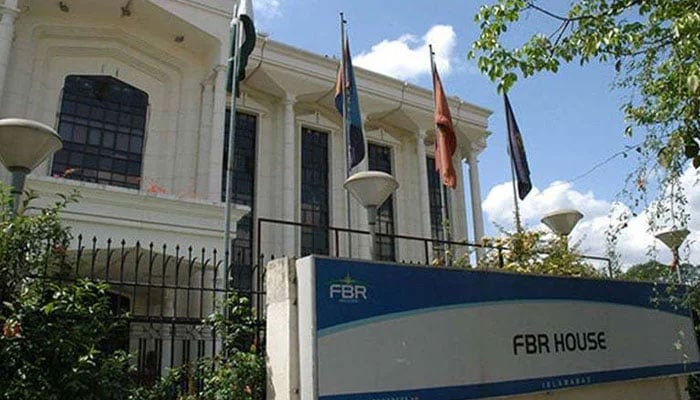
- Restructuring plan for the establishment of a board of professionals.
- The Minister presents proposals before high-ranking military officers.
- The proposal seeks to divide the tax machinery into two wings.
ISLAMABAD: The inter-ministerial committee has given the go-ahead to restructure the policy board of the Federal Board of Revenue (FBR) to end politically motivated appointments, it said. The news on Saturday.
The committee, constituted under the Special Investment Facilitation Council (SIFC), met in the presence of Chief of Army Staff (COAS) General Asim Munir and approved the restructuring of the FBR policy board. It will not now include bureaucrats, technocrats, economists and tax experts.
Under the current structure, the FBR’s policy board consists of nominees of the Speaker of the National Assembly and the Speaker of the Senate. However, under the proposed mechanism, such politically motivated appointments will be abolished.
The IMF technical team had recently undertaken the restructuring and policy actions of the FBR to reform the country’s tax system. The World Bank had also approved RISE-II and Pakistan Raises Revenues (PRR) to streamline the FBR overhaul, which remained a pipe dream despite securing multi-million dollar loans in the past.
FBR chairman Amjad Zubair Tiwana said The news that the SIFC had not formally approved the restructuring and the proposals were referred to the inter-ministerial committee. He explained that the recommendations will be finalized after the minutes of the meeting are issued.
However, sources privy to the development told the publication that caretaker finance minister Dr Shamshad Akhtar made a presentation on the plan before senior officials of the military establishment.
As part of the first step, the policy board of the FBR will be overhauled and top bureaucrats, technocrats, economists and tax experts will be included in it so that the authority functions professionally.
Further, the tax machinery will be divided into two wings, the FBR and the Federal Board of Customs (FBC). The proposal also suggests that the jurisdiction of policy wing and operation wing of FBR will be transferred to finance ministry and revenue department respectively.
Internal Revenue Service (IRS) will take care of income tax sales tax and federal excise tax (FED) where the director general should take care of three important taxes.
The IMF technical team had suggested to the government the establishment of a National Tax Authority (NTA), but this would not be feasible at this time. However, once an elected government is in place, it will be forced to turn to the NTA if it chooses to enter into a new three-year medium-term program once the existing stand-by agreement (SBA) expires in April 2024.
Although the NTA can be set up as an umbrella organization but it would require political support and the support of the federal units to ensure that it is up and running.
The FBR has already appointed regional revenue officers to widen the tax base. It remains to be seen how the ties with the provinces will be established.
The provinces are reluctant to transfer back any powers to the Centre, which were enshrined in the 1973 Constitution and also protected by the 18th Amendment.
While referring to Article 147 of the Constitution, which states: “Notwithstanding anything contained in the Constitution, the government of a province with the consent of the federal government delegates either conditionally or unconditionally to the federal government or its officers functions in relation to any matter to which the executive power of the province extends; provided that the provincial government shall ratify the duty assigned by the provincial assembly within sixty days.”
Citing this article of the Constitution, the official said the provinces could shift the responsibility of collecting agricultural income tax, GST on services and property tax to the FBR while the NTA could use the manpower of both FBR as well as FBC for the collection of provincial taxes. which would be transferred to the provinces after deducting the fee.
However, it remains to be seen how things will move in the desired direction in the coming months, the sources concluded.
a href=”https://www.geo.tv/latest/525916-committee-green-lights-plan-to-rid-fbr-policy-board-of-politically-motivated-appointments”>Source link



