
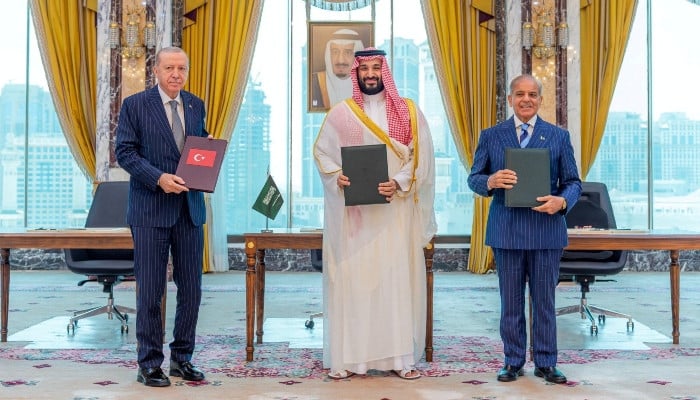
The trilateral defence pact signed in Makkah is being read in Islamabad as a security arrangement whose largest dividend may prove economic rather than military (Geo News, citing The News).
The scale is not in dispute. Together, Pakistan, Saudi Arabia and Turkiye represent an economic bloc worth more than $3 trillion — Turkiye at around $1.4 trillion, Saudi Arabia at nearly $1.28 trillion and Pakistan at roughly $410-420 billion — and a market of close to 380 million people running from the Gulf to South Asia.
What is in dispute is how much of that translates. Commercial engagement has consistently lagged the diplomatic relationship. Pakistan’s annual trade with Saudi Arabia is estimated at $4-5 billion and with Turkiye at only $1.3-1.5 billion. Saudi-Turkish trade, by contrast, has already passed $8.5 billion, with both governments targeting $10 billion in the near term and $30 billion longer out. Pakistan is the smallest leg of the triangle by some distance.
Some movement predates the pact. Pakistan is seeking a $6.7 billion concessional oil financing facility from Saudi Arabia over 15 years, including a five-year grace period, at a proposed 1 per cent. Officials at the Ministry of Economic Affairs have confirmed discussions are under way. It would replace the earlier deferred oil payment arrangement, which provided $1.2 billion at around 6 per cent and expired earlier this year — a fivefold increase in size at a sixth of the cost, if it lands.
Through the Special Investment Facilitation Council, Riyadh has announced plans to invest up to $10 billion across mining, refining, petrochemicals, renewable energy, agriculture, logistics, ports, healthcare and digital infrastructure, with Saudi participation in the Reko Diq copper and gold project among the flagship items.
Turkish capital is moving on a smaller but more concrete scale. Turkish companies have invested more than $2 billion in Pakistan over two decades. The Turkish Petroleum Overseas Company recently signed five petroleum concession agreements — three offshore, two onshore — marking its entry into Pakistan’s upstream sector, with about $300 million in exploration spending expected and two seismic survey vessels due on the offshore Indus Block-C later this year. Several Turkish firms have also expressed interest in the privatisation programme, including the proposed acquisition of the Faisalabad Electric Supply Company.
Defence manufacturing is where the three fit together most obviously. Pakistan and Turkiye already cooperate in naval shipbuilding and aerospace, while Saudi Arabia’s Vision 2030 targets localising half the kingdom’s defence procurement. Analysts see scope for joint ventures in drones, naval vessels, armoured vehicles, electronic warfare systems and ammunition, combining Saudi capital, Turkish technology and Pakistani manufacturing.
The caution is the important part. Economists warn against expecting an investment boom to follow from a defence agreement. Investors will still assess macroeconomic stability, the regulatory and tax framework, legal protections, energy availability and the ease of doing business — and Pakistan continues to face policy inconsistency, infrastructure bottlenecks, energy shortages and chronic delays in executing large projects. Announced investment and deployed investment have historically been very different numbers here.
The test, on this reading, is not whether the pact is signed but whether strategic trust converts into factories, infrastructure and jobs — and that conversion depends on decisions taken in Islamabad rather than in Riyadh or Ankara.



