
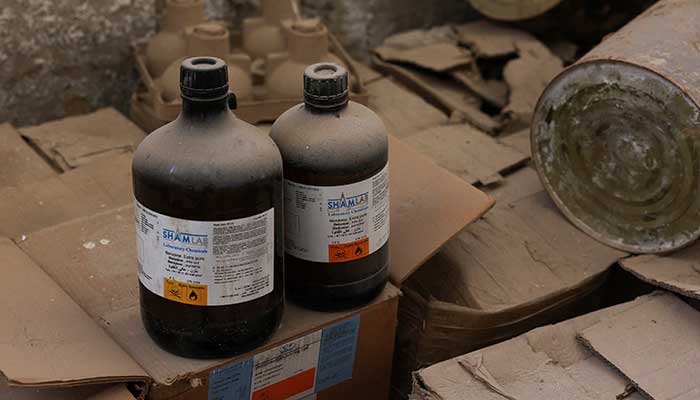
DUMA: The industrial-scale drug lab was just up a hill from a main road on the western edge of Damascus, the city that has been the seat of power for the Assad family, which has long denied any connection to the drug trade.
President Bashar al-Assad’s government in Syria has been accused by Washington and others of profiting from the production and sale of the addictive amphetamine-like stimulant commonly known as captagon, which has taken hold across the Middle East from the front lines of wars to construction sites and high-end parties.
The annual trade in captagon is worth billions of dollars a year, experts say, and Western governments have linked the illicit trade in Syria to Assad’s brother, Maher al-Assad, and the Syrian army’s Fourth Division he commanded.
Maher Assad’s whereabouts are unknown Reuters He could not be reached for comment on the allegations.
The fall of Bashar Assad after a lightning assault by rebels allowed journalists to begin searching Syria for evidence of the captagon’s empire for the first time.
In the dark, cavernous warehouses at the abandoned site in the town of Douma, the fighters who ousted Assad said they found thousands of pills hidden in furniture, fruit, decorative pebbles and voltage stabilizers that Reuters reporters saw them stacked on pallets, with a trailer waiting outside.
Many of the pills were stamped with the double crescent logo or the word “Lexus” denoting captagon pills.
“These are ready for export,” said one of the fighters loyal to Syria’s new rulers who took over Reuters reporters inside and then opened one of the devices ready for extraction, revealing the pills hidden inside.
Caroline Rose, director of the New Lines Institute Captagon Trade Project, based in New York, said the global trade in captagon has an estimated value of $10 billion and the ousted Syrian leadership’s annual profit from it is about $2.4 billion.
Rose, whose agency tracks all publicly recorded captagon seizures and lab raids, said the site they saw Reuters it appeared to be one of the largest captagon labs ever found.
“It is very likely the largest that existed in regime-controlled Syria,” he said.
Inside was a pill press and, in the warehouse above, dozens of barrels, boxes and bottles of various chemicals.
They included chloroform, potassium iodide, formaldehyde solution, ammonia solution sg 0.91, acetic acid, hydrochloric acid, cyclohexanone and petroleum ether 40-60 degrees Celsius.
The chemicals were produced in countries including Britain, China, India, Oman, Saudi Arabia and Lebanon, according to the labels.
Captagon was the brand name of a stimulant first produced in Germany in the 1960s to help treat attention disorders, including attention deficit disorders and narcolepsy.
It was discontinued, but an illegal version of the drug known as “poor man’s cocaine” continued to be produced in eastern Europe and later in the Arab world, and became prominent in the conflict that erupted in Syria after anti-government protests in 2011.
Creates focus and prevents sleep and hunger. It has been banned in many countries, including the US, and can have harmful side effects. Its prevalence has led to increasing drug abuse in the Arab Gulf states.
a href=”https://www.geo.tv/latest/579391-discovery-of-vast-syrian-drug-lab-reveals-secrets-of-illicit-trade”>Source link



