
KARACHI:
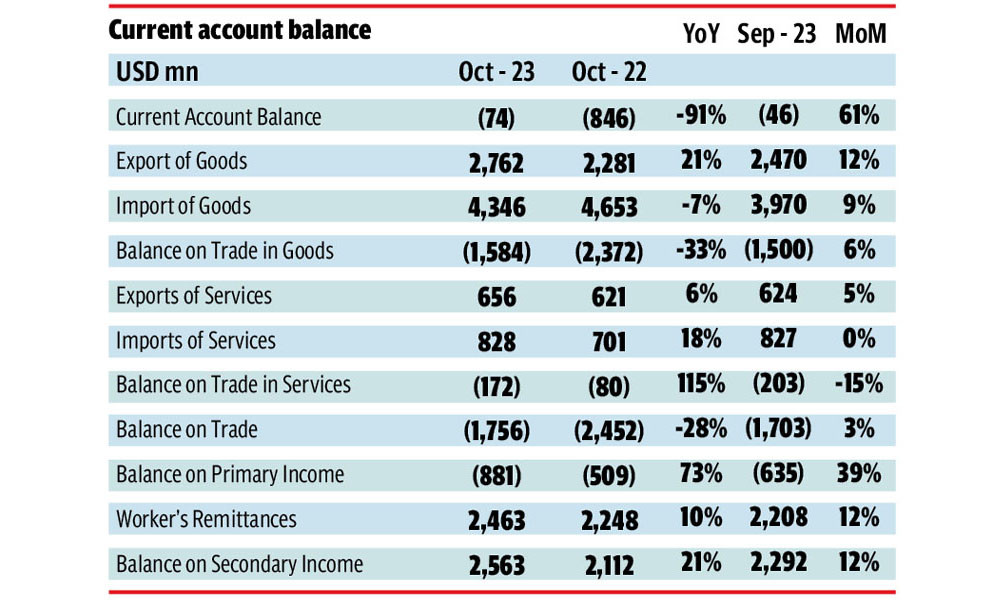
Pakistan’s current account balance hit a record high for the second consecutive month in October, recording a nominal deficit of $74 million and suggesting that the country’s external economy and balance of payments situation are steadily improving.
The State Bank of Pakistan (SBP) reported on Monday that the current account deficit stood at $74 million in October 2023, which was slightly higher than the deficit of $46 million in the previous month, showing a 61% month-on-month increase in a month (Mom).
Speaking to the Express Tribune, Pak-Kuwait Investment Company’s Head of Research Samiullah Tariq observed that “this shortfall ($74 million) is largely manageable.”
The central bank has revised the deficit for September to $46 million from the $8 million figure reported earlier.
The rise in the monthly deficit was mainly due to a 9% rise in goods imports, which rose to $4.20 billion in October compared to $3.97 billion in September.
On the other hand, a notable 12% increase in workers’ remittances to $2.46 billion and a 12% improvement in export earnings to $2.76 billion in October helped to maintain the current account deficit at an affordable level. They largely offset the impact of an increase in goods imports of over $4 billion.
Optimus Capital Management analyst Maaz Azam commented that “increase in remittances and exports kept the current account deficit in check.”
The improvement in imports is necessary to give a new impetus to the economy because many industrial units depend on the purchase of raw materials from foreign markets. Pakistan’s low foreign exchange reserves, however, do not allow for a liberal import policy, as imported goods are mostly consumed locally rather than contributing significantly to exports.
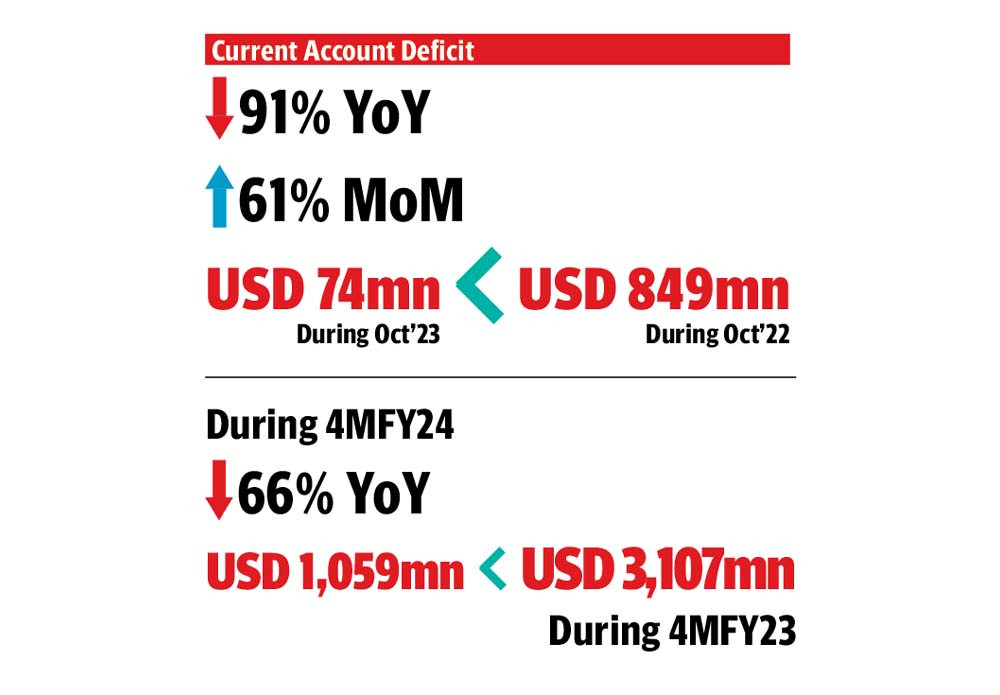
On an annual basis, the current account deficit shrank by 91% in October compared to the same month a year earlier, according to JS Global Research. The research house characterized the $74 million shortfall as a one-off.
According to the central bank, the deficit for the first four months (July-October) of the current financial year shrank by a staggering 66% to $1.05 billion from $3.10 billion in the corresponding period last year.
“Setting a nominal amount of less than $100 million per month to finance the deficit is manageable compared to a current account deficit of more than $2 billion per month recorded in some of the months in fiscal year 2021,” he pointed out. Azam.
“The deficit will remain affordable in the range of $100-200 million a month going forward, considering the country’s low foreign exchange reserves of around $7.5 billion that provide less than two months of import coverage,” he said.
The analyst warned that an increase in the deficit to $400-500 million per month would be troublesome unless Pakistan sees significant foreign exchange inflows and an improvement in foreign exchange reserves.
Tariq noted that the current account deficit remained under control despite the fact that foreign companies in Pakistan are freely repatriating profits and dividends to their overseas headquarters after a gap of almost a year and a half, amid improving foreign exchange reserves.
He was of the opinion that imports of goods of just over 4 billion dollars looked good and supportive for the revival of economic activities.
He added that the inflation reading is expected to ease to 20-22% in the current financial year against 29% in 23. This, however, is still elevated, hampering economic growth.
A possible modest growth of 2-3% in year 24 is well below the required expansion of more than 6% to create job opportunities for the large number of workers entering the labor force each year.
The central bank’s target of controlling and maintaining inflation between 5% and 7% next fiscal year will help the economy turn around and achieve the growth it needs.
Hence, controlling inflation and improving export earnings and workers’ remittance inflow will be the main challenges.
Foreign direct investments
Meanwhile, Arif Habib Limited reported that Pakistan received net foreign direct investment (FDI) of $122 million in October 2023, down 13 percent compared to $140 million in the same month last year.
On a monthly basis, FDI in various sectors of the economy decreased by 29%. In the first four months of the current fiscal year, however, net FDI rose 7% to $525 million compared with inflows of $490 million in the corresponding period last year.
Published in The Express Tribune, November 21St2023.
Like Businesses on Facebook, follow @TribuneBiz on Twitter to stay updated and join the conversation.
a href=”https://tribune.com.pk/story/2447363/ca-deficit-reaches-breakeven”>Source link



