
More than 160,000 disappeared under Assad’s rule, believed to be buried in dozens of mass graves, rights groups say
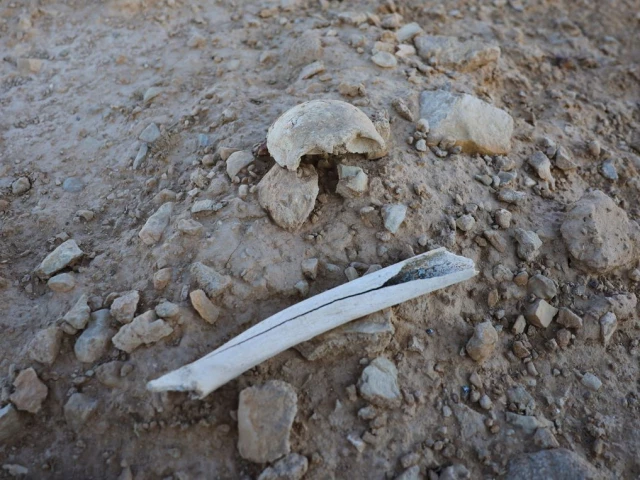
A bone fragment, which experts believe is part of a human leg, was found on the surface of the mass grave in the Dhumair desert. PHOTO: REUTERS
For nearly two years, the stench of death rose from a Syrian desert highway. Night after night, trucks moved thousands of bodies from one mass grave to another, part of a secret effort ordered by President Bashar al-Assad’s palace to cover up evidence of mass killings.
A Reuters investigation revealed how Operation Earth Move moved the remains of thousands from a known mass grave in Qutayfa, near Damascus, to a new, secret burial site in Dumayr, a military zone an hour away. Satellite and drone images, supported by forensic terrain analysis, show how trenches were dug, reopened and refilled as bodies were moved under the cover of darkness.
Thirteen witnesses — drivers, engineers, soldiers and officials — described the two-year operation under Colonel Mazen Ismandar, known to subordinates as Assad’s “cleansing master.” The orders were verbal. phones were banned. Anyone who spoke risked death.
Read more: Syria pledges to honor previous agreements with Russia
The Qutayfah Tomb, exposed by activists during the civil war, once held victims of torture, detention and combat. By 2019, with Assad consolidating victory, the regime began to purge it. Witnesses said the aim was to eliminate traces of war crimes before international scrutiny resumed.
At least 34 trenches, stretching two kilometers across the Dhumair desert, now hold the dead. Satellite evidence shows trucks moving between the two sites from 2019 to 2021, carrying dirt, bones and rotting remains. Experts believe tens of thousands are buried there.
After Reuters revealed the reburial plan, Syria’s new National Commission for the Missing said it would seek to seal and protect the Dhumair site, warning that chaotic transport would complicate future identification.
Documents, testimony and images reviewed by Reuters trace the chain of command from Assad’s inner circle through the army’s Medical Services, where Ismandar and General Ammar Suleiman oversaw the mass burials. Witnesses said Assad authorized the transfer to “cleanse” the country before it reopened to the public.
When the final trench was sealed in April 2021, the Qutayfa site was bulldozed. The land still bears the marks.
a href=”https://tribune.com.pk/story/2572934/assad-regime-moved-mass-graves-to-conceal-war-crimes”>Source link



