
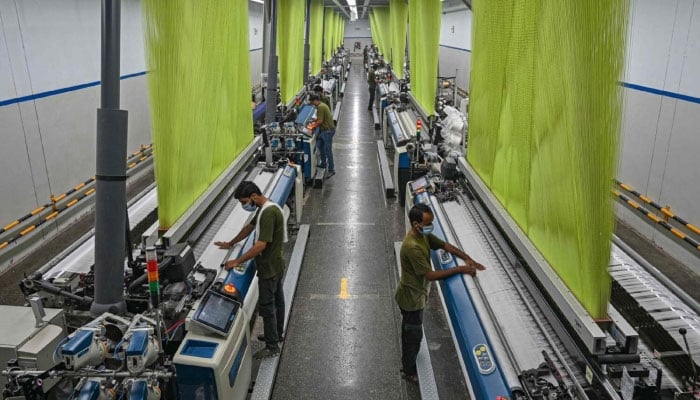
The devastating effects of high energy costs have forced many mill owners to close their businesses
- Natural gas duties increased by 60% from August 2022.
- The gas tariff is expected to increase further in the coming months.
- High energy costs also forced the closure of industries.
LAHORE: Pakistan’s textile industry, which is a key export sector of the country, is suffering from high energy costs and a weakening currency, making it less competitive in the global market, The news it said on Sunday, citing industry officials.
Following the rise in international liquefied natural gas (LNG) prices, the caretaker government has increased natural gas duties by more than 60% from August 2022.
The latest hike, effective from November 2023, pushed the gas tariff to $10,847 per million British thermal units (mmBtu) for Punjab-based textile units and $9,739 for Sindh-based units, in compared to $6.5 in July 2022.
The natural gas tariff is expected to rise further in the coming months as the Petroleum and Natural Gas Regulatory Authority (Ogra) has linked it to the price of LNG delivered by ship (DES), which increased by 10.11% for December 2023.
The natural gas tariff is poised to jump, perhaps as much as $13-plus per unit, in the coming months according to the RLNG rates announced by the regulator.
Not only has the rising cost of natural gas made the local textile industry uncompetitive in international trade, but the unwelcome growth has also brought the export-oriented industry to a standstill as energy capture costs exceed grid capacity rates.
According to analysts, most of the generation cost of captive power plants with such a high gas tariff has crossed Rs 45 per unit, which is more than the utility tariff for the industry today. In this challenging development, only efficient plants, costing up to Rs 38 per unit cost of electricity, could generate electricity at high RLNG tariff. Only about one-fifth of the industry has set up efficient facilities in recent years in Punjab province.
“If you are unable to generate electricity domestically due to high generation costs, you will also be exposed to scarce power from the grid, making the generation process less efficient,” according to an industry official.
“The next two months for the textile industry will be very difficult in terms of securing a competitive and reliable source of energy.”
Although the government provided the textile industry with subsidized RLNG at $9.0 per mmBtu, this rate was even above the regional average for countries such as India, Bangladesh and Vietnam. This single point reduced the competitiveness of the country’s exports. Moreover, with the withdrawal of regional competitive tariff and the imposition of a fixed power tariff of Rs 20/kWh earlier and now its withdrawal, the cost of electricity from the national grid has also doubled.
The devastating effects of high energy costs have forced many mill owners to close their businesses. Late last year, the All Pakistan Textile Mills Association (APTMA) reported that over 1,500 textile mills were forced to close due to hike in electricity and gas tariffs.
One of the most important aspects of this connection was the interruption of the supply of electricity and natural gas. The composites sector is particularly dependent on an uninterrupted supply of electricity and natural gas. Interruptions in power supply and restriction of gas supply or low pressure seriously impair the performance of the textile plant.
The country’s textile industry is at a disadvantage due to high level of regional competition from players such as India, Bangladesh, Vietnam, Uzbekistan and Sri Lanka.
It is pertinent to mention here that natural gas remains the main or sole source of energy for 75% of the textile industry, which consumes only about 8% of the national natural gas supply. Therefore, any disconnection of natural gas or its prohibitive cost has serious implications for the local textile industry and export orders.
a href=”https://www.geo.tv/latest/524264-textile-sector-likely-to-face-another-gas-tariff-hike-amid-soaring-lng-prices”>Source link



