
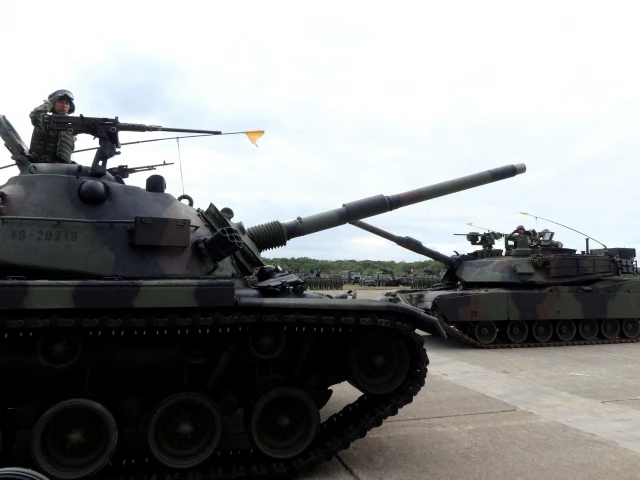
Taiwan will introduce a supplementary defense budget of $40 billion to underline its determination to defend against the growing threat from China, President Lai Ching-te said on Wednesday.
China, which regards democratically-ruled Taiwan as its own territory, has stepped up military and political pressure over the past five years to assert its claims, which Taipei strongly rejects.
As Taiwan faces calls from Washington to spend more on its own defense, mirroring US pressure in Europe, Lai said in August he hoped to boost defense spending to 5 percent of gross domestic product by 2030.
Unveiling the T$1.25 trillion ($39.89 billion) package, Lai said history has proven that trying to compromise in the face of aggression has brought nothing but “subjugation”.
“There is no room for compromise on national security,” he told a news conference at the presidential office.
“National sovereignty and the core values of freedom and democracy are the very foundation of our nation.”
Taiwan’s Defense Minister Wellington Ku said the budget, which will run from 2026-2033, will cover items such as missiles and drones as well as the new “T-Dome” air defense system.
Determination to defend
Lai, who first announced the new spending plan in a Washington Post op-ed on Tuesday, said Taiwan was showing its determination to defend itself.
“It is a struggle between defending democratic Taiwan and refusing to succumb to becoming ‘China’s Taiwan,'” he added, rather than just an ideological struggle or a “unification vs. independence” dispute.
Lai had previously highlighted the extra defense spending but did not elaborate.
The de facto US ambassador to Taipei, Raymond Greene, wrote on Facebook that the United States supports Taiwan’s “rapid acquisition of critical asymmetric capabilities.”
“Today’s announcement is an important step toward maintaining peace and stability in the Taiwan Strait by strengthening deterrence,” he added.
Taiwan is modernizing its armed forces to promote an “asymmetric” approach to warfare to make its forces, which are much smaller than China’s, flexible and able to pack a bigger and more targeted punch.
For 2026, the government projects that such spending will reach T$949.5 billion ($30.3 billion), to rise to 3.32% of GDP, breaking the 3% mark for the first time since 2009.
The spending would have to be approved by Taiwan’s opposition-dominated parliament.
Reading: Xi says Taiwan’s “return” to China is key to global order in conversation with Trump
Cheng Li-wun, chairwoman of Taiwan’s main opposition party, the Kuomintang, has previously rejected increased defense spending. On Wednesday, he did not directly say the party would vote against the budget, but urged Lai to “walk away from the brink”.
“I also hope the international community can understand that the Taiwanese people love peace and firmly desire peace. We want to stay away from the flames of war, we want to avoid war,” Cheng told a party meeting.
Lai’s announcement comes as China and Japan are embroiled in a bitter dispute over Taiwan, after Japanese Prime Minister Sanae Takaichi said a hypothetical Chinese attack on Taiwan could prompt Japanese military action.
“Continuously unleashing multifaceted threats and attacks against neighboring countries at every turn is not the behavior expected of a responsible great power,” Lai said when asked about the issue, referring to China.
Speaking earlier in Beijing, a spokesman for China’s Taiwan Affairs Office said Taiwan was allowing “external forces” to dictate its decisions.
“They are wasting funds that could be used to improve people’s lives and develop the economy to buy weapons and curry favor with foreign powers,” spokesman Peng Qinggen told reporters.
“This will plunge Taiwan into disaster.”
The United States is bound by law to provide Taiwan with the means to defend itself, despite the lack of formal diplomatic ties.
relations with the USA
But since US President Donald Trump took office in January, he has approved only one new arms sale to Taiwan, a $330 million package for fighter jets and other aircraft components announced this month.
The United States plans to increase arms sales to Taipei beyond Trump’s first term in an effort to deter China, two US officials told Reuters in May.
“The international community is safer today because the Trump administration is pursuing peace through force,” Lai wrote in the Washington Post.
Lai said Taiwan’s ties with the United States were “solid,” when asked at the news conference if he was worried about Trump visiting China next year, given the improved Washington-Beijing trade relationship.
“Recently, before his trip to Asia, President Trump specifically emphasized that ‘Taiwan is Taiwan,’ and President Trump (said he) personally respects Taiwan. Those two short statements say it all,” Lai said, referring to comments Trump made during his visit to the region last month.
Lai says only the people can decide their future. Beijing has rejected his repeated proposals for talks, calling him a “separatist”.
a href=”https://tribune.com.pk/story/2579217/taiwan-unveils-40bn-defence-budget-to-counter-rising-pressure-from-china”>Source link



