
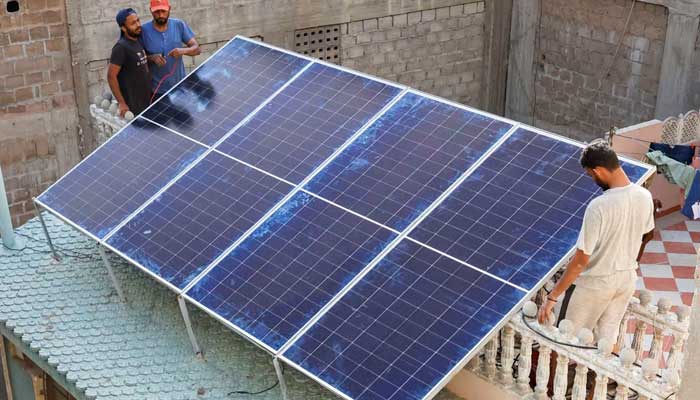
Pakistan’s energy consumption has seen remarkable changes in recent years, with many consumers turning to solar energy, including the country’s agricultural sector, with rows upon rows of solar panels becoming the new normal.
The increase in the solarization trend is reflected in the data gathered by BloombergNEF which shows that China’s imports of solar equipment in the first nine months of this year are well ahead of those for the whole of 2023.
The $1.7 billion purchases, according to the Bloomberg report, it would be equivalent to 17 gigawatts of electricity generation, more than a third of Pakistan’s total power, if all of it were deployed on rooftops and farms across the country.
For maize farmer Mohammad Murtaza, the panel installation allowed him to reduce his electricity bill by switching irrigation pumps from diesel or expensive electricity from the grid.
Farmers like him are the latest to join the solar craze, following households and factories, in a country where electricity prices for some have tripled since 2021 as the government cut subsidies to meet International Monetary Fund loan requirements .
This dizzying sunshine has many advantages. Including financial relief to consumers and businesses who can afford the panels.
Although it saves the government money on fuel imports and will help Pakistan move towards its goal of doubling renewable energy to 60% of the energy mix by the end of the decade.
But the rapid and unregulated boom also threatens to weaken the country’s utilities and destabilize the fragile economy.
“There is a big solar rush going on in Pakistan: the numbers are staggering,” said Muhammad Mujahid, chief executive of Lahore-based panel distributor Innovo Corporation.
But it also creates the “risk of a utility death spiral,” he added.
As many customers curtail their consumption from the grid or even leave it altogether, Pakistan’s electricity companies are permanently losing a significant chunk of demand and revenue.
State utilities have accumulated losses of Rs 2.4 trillion ($8.6 billion) between 2014 and 2023, according to government data. The IMF said that sustaining demand should be a key goal of reforms.
“Pakistan’s distribution companies are losing every day as solar becomes attractive,” said Salahuddin Riffai, who was chairman of Islamabad Electric Supply Co until 2022.
“The burden is constantly increasing on the remaining customers,” Rifai observed.
The country was already struggling financially after borrowing heavily from China under the Belt and Road Initiative over the past decade to build power generation capacity.
Pakistan is now in negotiations to try to extend the maturity of this debt. The government is also in talks with local power producers to revise or terminate purchase contracts and is considering privatizing some utilities as cost-cutting measures.
“If the government opens up the electricity market without curtailing solar capacity, most of the current generation fleet will sit idle,” said Syed Faizan Ali Shah, who is a member of the Prime Minister’s Sunshine Committee.
“So who’s going to pay for these power plants? That’s a big concern,” he warned.
The flood of solar panels from China began in 2023 and turned into a deluge after Pakistan lifted import restrictions late last year, making it the third-largest destination for Chinese panels, according to BNEF. They are now advertised on billboards in major cities and during cricket matches.
The frenzy was not limited to the energy sector as real estate firms and electronics companies also started flipping panels, with the biggest traders bringing in up to 250 megawatts worth each month, according to Usman Ahmad, managing director of solar company Nizam Energy . Pvt.
In demand were households and factories that make everything from cement to clothing, which have suffered frequent blackouts in the past due to the unreliable grid.
Speculation that the grid will collapse is “extreme,” but the drop in demand is indeed worrying, Energy Minister Awais Leghari said in an interview.
Utilities “need to be a little more sensitive to customer demands in terms of reliability and tariffs,” he said, adding: “We all realize that the status quo cannot prevail.”
a href=”https://www.geo.tv/latest/575866-solarisation-boom-beneficial-for-consumers-but-detrimental-for-grid”>Source link



