
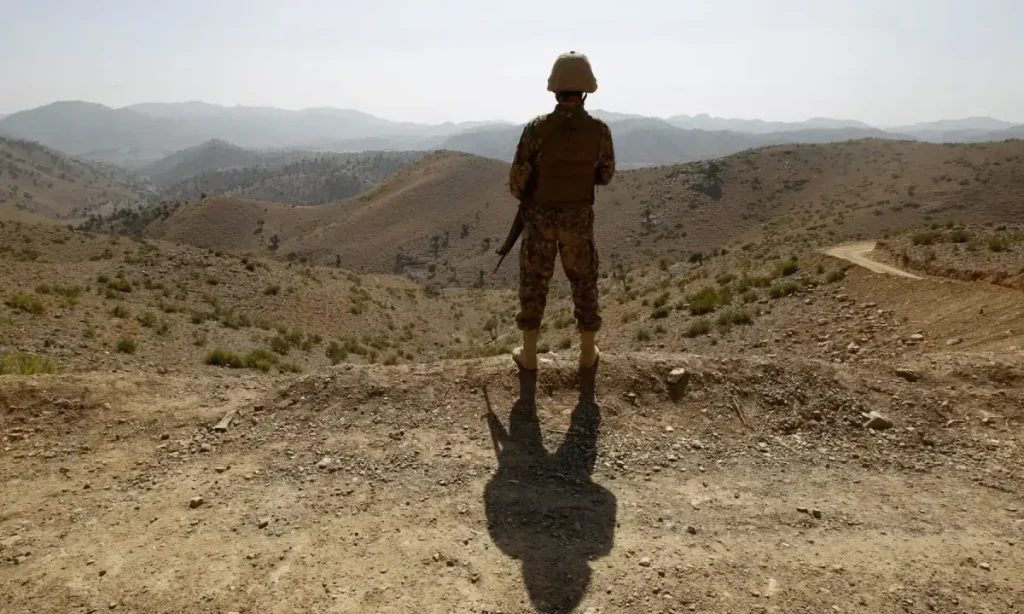
Pakistan’s military says its forces killed 48 militants in a sustained series of intelligence-based operations (IBOs) around Miranshah in North Waziristan over roughly a week in June, in one of the more intensive counter-terrorism pushes reported in Khyber Pakhtunkhwa’s tribal districts this year.
In a statement issued on June 13, the Inter-Services Public Relations (ISPR) said 21 militants had been killed in the latest phase of the operations, taking the cumulative toll to 48 across the campaign, according to The Express Tribune. The military said the killed included four “ring leaders” it named as Khalid Raza, alias Salar; Muftoon; Musa; and Imran, alias Ayan, the same report stated.
“Killed kharji ring leaders were highly wanted for their involvement in numerous terrorist activities, including the killing of security forces personnel and innocent civilians,” the ISPR said in remarks carried by The News. The military said weapons and ammunition were recovered from the slain men, though it did not detail quantities, the same outlet reported.
The June 13 announcement followed an earlier phase of the same campaign. On June 7, the ISPR said security forces had killed 27 militants over the preceding 72 hours after engaging “multiple khawarij locations in the general area Miranshah, North Waziristan District,” according to Dawn. That statement said sanitisation operations were continuing to clear any remaining fighters, the report added.
The military framed the June 7 operation as a response to the killing of Malik Saifullah Dawar, a prominent Miranshah tribal figure, saying his killers had been brought to justice, per Daily Pakistan’s account of the ISPR statement. The casualty figures, the identification of those killed and the attribution to specific commanders all rest on the military’s account; independent verification from the remote, access-restricted area is not available, and the claims could not be confirmed by this newspaper.
The ISPR refers to the targeted fighters as “Fitna al-Khawarij,” the state’s designation for the Tehreek-e-Taliban Pakistan (TTP) and affiliated groups. The military describes the campaign as part of its broader counter-terrorism vision, “Azm-i-Istehkam,” approved by the Federal Apex Committee on the National Action Plan, as noted in the ISPR statement reported by Dawn.
North Waziristan, which borders Afghanistan, has remained one of the most violence-affected districts in Khyber Pakhtunkhwa, with security forces and militant factions clashing repeatedly. The Express Tribune reported that President Asif Ali Zardari, Prime Minister Shehbaz Sharif and Interior Minister Mohsin Naqvi praised the troops involved, the outlet stated.
The military has not reported any soldier casualties in connection with the June operations in its statements carried by Dawn, The Express Tribune or The News.
The TTP, which the government formally banned years ago, has stepped up attacks on security forces in Khyber Pakhtunkhwa since a 2022 collapse of a fragile ceasefire, and the tribal districts of North and South Waziristan, Bannu and Bajaur have borne much of the resulting violence.



