
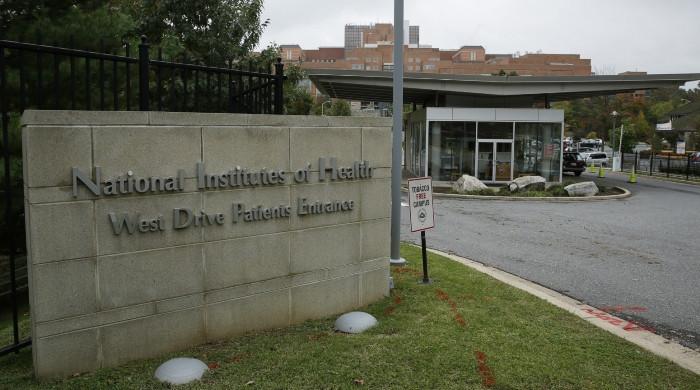

The US Medical Research Service has announced a significant reduction in funding in universities and research centers, a move strongly condemned by scientists and academics who say that work on cancer and other diseases will suffer.
The National Institutes of Health (NIH) said late Friday that it set a 15% threshold in funding for “indirect” or general costs linked to research.
This represents a dramatic decline, amounting to billions of dollars, from indirect bills to 60% now charged by some organizations, the organization said.
“This change will save more than $ 4b a year immediately,” the official NIH account said in X.
He said it was “vital to ensure that as many funds are going to immediate cost of scientific research”.
The expense they are targeting include maintenance, equipment and administrative expenses in research laboratories.
The cut could affect research in diseases such as cancer and neurodegenerative conditions such as Alzheimer’s and Parkinson diseases, scientists said.
“This is a sure way to seduce research and innovation,” said Matt Owens, president of Cogr, who represents research institutions and university medical centers, in a statement to AFP.
“America’s competitors will enjoy this self -injured trauma,” he said. “We urge NIH leaders to cancel this dangerous policy before its damage is felt by the Americans.”
Jeffrey Flier, a former dean of Harvard University Medical School, told X that the approach of President Donald Trump’s administration “was designed not to improve the process, but to harm institutions, researchers and biomedical research”.
He said that “it will cause chaos and harm biomedical research and researchers.”
The White House defended the move on Saturday, saying it had the indirect cost rates according to the measurements used by the foundations of the private sector.
“NIH has announced a new policy of indirect expenditure that is in line with research institutions from private institutions,” a statement said.
“The indirect cost is aimed at covering the general costs and the federal government pays an overly high interest rate.”
Institutions that may be influenced by cuts have stated that indirect expenses pay for “basic” tools that allow research.
“Targeted funds pay for the basic tools, facilities and support personnel that make it possible to research, maintain laboratories to accommodate experiments, electricity to maintain centrifugal spins and computers to protect clinical data behind Medical remedies, “said a spokesman for Johns Hopkins University.
Scientists have expressed their concern in recent weeks during the lack of transparency, as the new administration removes the reconstruction of epidemiological data from health -related government websites.
NIH’s announcement was rejoiced by Elon Musk, billionaire Trump adviser who led to an attempt to drastically limit federal spending.
Some Republican legislators have welcomed the measure, which is likely to have the greatest impact on recognized research universities such as Harvard, Yale and Johns Hopkins.
a href=”https://www.geo.tv/latest/589794-scientists-deplore-sharp-us-cut-in-medical-research-funding”>Source link



