
KARACHI:
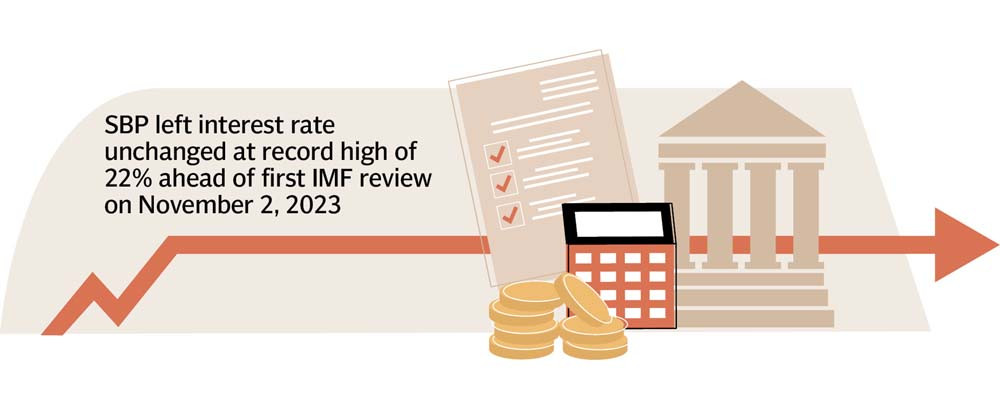
Pakistan’s central bank on Monday left its key policy rate unchanged at a record high of 22 percent ahead of the International Monetary Fund’s (IMF) first review of its $3 billion loan program.
“The MPC (monetary policy committee) noted that the successful and timely completion of the upcoming IMF-SBA (standby arrangement) review would help free up other multilateral and bilateral financing,” the State Bank said in announcing the monetary policy.
The bank said it would maintain “tight monetary policy” for now, but indicated that the policy rate had peaked at the current level.
In its latest monetary policy statement for the next six weeks, the State Bank of Pakistan (SBP) reiterated its earlier view “that the real policy rate (inflation minus the policy rate) is significantly positive on a 12-month forward basis.”
The bank refrained from cutting interest rates now as it appeared to be waiting for inflation to ease from October onwards.
It said inflation hit a four-month high of 31.4% in September 2023, according to its forecast. He believes that inflation will slow down aggressively in the second half (January-June) of the current financial year.
Reading SBP keeps the key policy rate unchanged at 22%.
Experts expect the central bank to make its first policy rate cut between December 2023 and March 2024, noting that the expected drop in monthly inflation to 15-16% by the end of June 2024 will encourage the bank to make a cumulative cut of 4-5 percentage points in the contract interest rate.
With the downward revision, economic activities in the country will get some boost.
“Recent data on economic activity reinforces the MPC’s earlier expectations of moderate growth (2-3%) for this year,” the SBP said. The SBP left the key interest rate unchanged for the third consecutive time in the last four months.
Risk factors
The SBP said the current policy rate was appropriate to reduce inflation to its medium-term target of 5-7% by the end of the 25th year. “However, the MPC noted that this outlook is based on continued fiscal consolidation and timely implementation of planned external inflows.”
The central bank also highlighted the risks to the expected slowdown in inflation, saying that the crisis in the Middle East (Palestine-Israeli War) and related volatility in global oil prices could prolong the period of high inflation.
“While recent volatility in global oil prices as well as an increase in natural gas tariffs from November 2023 pose some risks to the FY24 outlook for inflation and the current account, the MPC also noted some offsetting factors.
“These include targeted fiscal consolidation in the first quarter, improved commodity market availability and the alignment of interbank exchange rates and the open market.” Core inflation (inflation excluding food and energy) has remained high at around 21% over the past four months.
Economic activities are increasing
The latest estimates of major Kharif crops including cotton, paddy (rice), sugarcane and maize show a significant increase compared to last year. These improved crop estimates were supported by higher fertilizer uptake and better water availability, the bank said.
Also, modest recovery in other key indices such as cement, POL (petroleum, oil and lubricants) and auto sales are gaining ground. In addition, large-scale manufacturing (LSM) output showed a gradual improvement in the first two months of this year, with the major contribution coming from domestic sectors, he added.
read more Only the monetary interest rate can “fix the economy”
The central bank said it had noted four major developments since its last monetary policy in September 2023. First, initial estimates for Kharif crops are encouraging and will have positive effects on other key sectors of the economy.
Second, the current account deficit narrowed significantly in August and September, which helped stabilize the SBP’s foreign exchange reserves amid low external financing in the two months.
Third, fiscal consolidation remained on track, with both fiscal and primary balances improving in Q1 2024.
Fourth, while core inflation remains steady, both consumer and business inflation expectations improved in the latest pulse polls. However, global oil prices remain quite volatile and the conflict in the Middle East makes its outlook even more uncertain.
The SBP noted that the current account deficit improved by 58% to $947 million in July-September 2014 compared to the corresponding period of the previous year, while almost flatlining in September 2023. Both exports and remittances of workers improved in September over the previous two months. Improved inflows into the interbank market helped stabilize foreign reserves around $7.5 billion as of October 20, 2023.
In the first quarter of FY24, the fiscal deficit improved amid better revenue collection and restrained expenditure. FBR’s revenue showed a growth of 24.9% over the same period last year.
Similarly, non-tax revenue almost doubled mainly due to a sharp increase in the collection of petroleum development levies (PDL) due to rates. Spending remained at last year’s levels, supported by a significant reduction in subsidies and grants.
Published in The Express Tribune, October 31St2023.
Like Businesses on Facebook, follow @TribuneBiz on Twitter to stay updated and join the conversation.
a href=”https://tribune.com.pk/story/2443831/sbp-maintains-tight-monetary-policy”>Source link



