
Yemeni council chief Alimi has canceled a defense pact with the United Arab Emirates, accusing it of supporting STC unrest
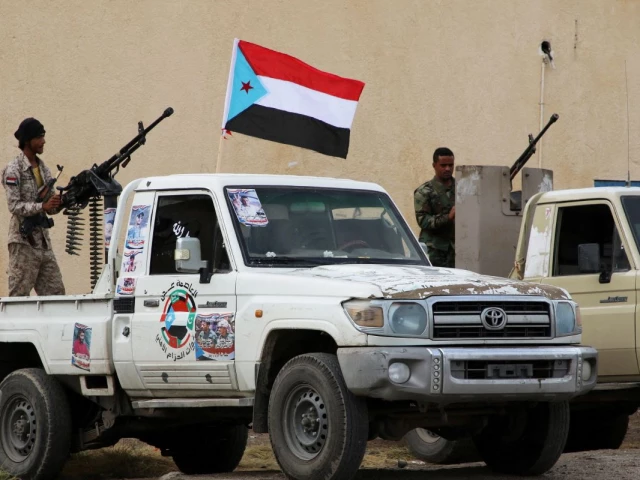
FILE PHOTO: Security forces loyal to the separatist Southern Transitional Council hold weapons while standing on the back of vehicles as they are deployed in the southern port city of Aden, Yemen, December 20, 2020. PHOTO: REUTERS
Saudi Arabia said on Tuesday that its national security was a red line and backed a call for United Arab Emirates forces to leave Yemen within 24 hours, shortly after a Saudi-led coalition airstrike on the southern Yemeni port of Mukalla.
The warning marked Riyadh’s strongest language against Abu Dhabi as the coalition said it hit back at what it described as foreign military support for the UAE-backed southern separatists. The head of Yemen’s Saudi-backed presidential council also set a deadline for Emirati forces to withdraw, calling on the UAE to comply.
Saudi Arabia and the United Arab Emirates are both major players in the OPEC oil-exporting group, and any disagreement between the two could hinder consensus on oil production decisions. The team is scheduled to meet virtually on Sunday.
The head of Yemen’s presidential council, Rashad al-Alimi, canceled a defense deal with the United Arab Emirates, Yemen’s state news agency reported, and accused Abu Dhabi in a televised address of stoking internal strife in Yemen through its support for the Southern Transitional Council (STC).
“Unfortunately, it has been conclusively confirmed that the UAE pressured and led the STC to undermine and rebel against state authority through military escalation,” Alimi said.
The UAE foreign ministry did not immediately respond to a request for comment.
Major Gulf stock indexes traded lower on Tuesday after the escalation of tensions.
The attack brought the allies closer to confrontation
The UAE was part of the Saudi-led coalition fighting the Iran-aligned Houthi movement in Yemen. In 2019, it began withdrawing its troops but remained committed to the internationally recognized Saudi-backed government.
The STC later sought self-rule in the south and this month launched a surprise attack on Yemeni government troops backed by Saudi Arabia, bringing the Gulf allies closer than ever to direct confrontation and risking a new civil war.
Read more: Saudi-led coalition targets Yemen’s Mukalla dock for alleged STC arms delivery
The advance broke years of stalemate, with the STC claiming broad control of southern Yemen, including the strategically important province of Hadramout. Saudi Arabia had warned the STC of military moves in Hadramout and demanded the withdrawal of its forces, a call the STC rejected.
Mukalla strike
The coalition said a limited airstrike early Tuesday followed the weekend arrival of two ships from the UAE port of Fujairah, which it said docked in Mukalla on Saturday and Sunday without permission.
After arriving, the vessels disabled their tracking systems and unloaded large quantities of weapons and combat vehicles to support the STC, the coalition said. Saudi state media released video of a ship identified as the “Greenland”, which it said came from Fujairah and was used to unload military equipment.
The coalition said the attack caused no casualties or collateral damage. Two sources told Reuters the strike targeted the dock where cargo from the two ships had been unloaded. Reuters could not independently verify what was hit or the nature or origin of the cargo.
Footage broadcast by Yemeni state television showed black smoke rising from the port and burning vehicles at the site in the early hours after the strike.
Following the incident, Alimi imposed a 72-hour no-fly zone and a sea and land embargo on all ports and crossings, except for exceptions approved by the coalition.
Hadhramout borders Saudi Arabia and has deep cultural and historical ties to the kingdom, with many prominent Saudis tracing their ancestry to the region.
STC rejects orders
Aidarous al-Zubaidi, head of the STC and deputy head of the presidential council, said in a joint statement with three other council members that the UAE remains a key partner in the fight against the Houthis.
The statement rejected Alimis’ orders, saying they were not consensual.
“We categorically state that no person or entity within or outside the leadership council has the authority to remove any country from the Arab Coalition,” the statement said. “This is a matter governed by regional frameworks, alliances and international agreements that are not subject to whims or individual decisions.”
As of 2022, the STC is part of an alliance that controls southern areas outside of Houthi control under a Saudi-backed power-sharing initiative. The Houthis control northern Yemen, including the capital Sanaa, after forcing the Saudi-backed government to flee south.
“We will continue to prevent any military support from any country to any Yemeni faction without coordination with the legitimate government,” the coalition said.
a href=”https://tribune.com.pk/story/2584640/saudi-arabia-calls-national-security-a-red-line-urges-uae-exit-from-yemen”>Source link



