
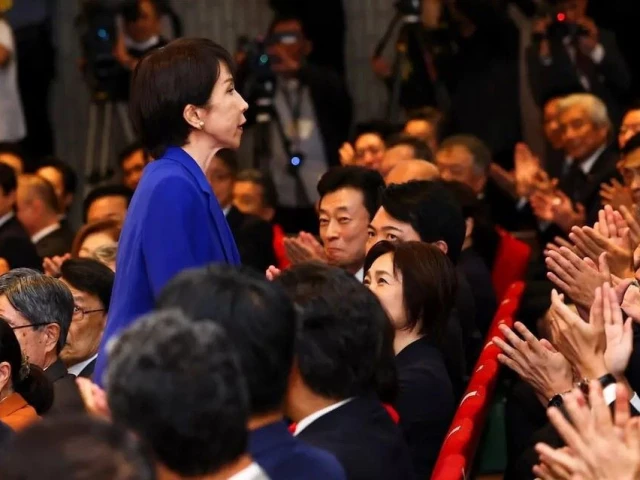
Japan’s ruling party chose the Hardline Conservative Sanae Takaichi as her head on Saturday, placing her on the way to become the country’s first prime minister in a move that put investors and neighbors.
The Liberal Democratic Party, which has ruled Japan for almost all of the post -war era, has elected Takaichi, 64, to regain confidence from an audience that was enraged by rising prices and to draw on opposition groups that promise stimulus and destruction.
Voting in parliament to choose a replacement for the outgoing Shigeru Ishiba is expected on October 15. Takaichi is favored as the ruling coalition has the largest number of positions.
Inherits the party in crisis
Takaichi, the only woman among the five LDP candidates, prevailed in a runoff against the most mediocre Shinjiro Koizumi, 44, offered to become the youngest modern -day leader in Japan.
A former Minister of Finance and Home Affairs with an expansive budgetary agenda for the fourth largest economy in the world, Takaichi is taking over a crisis party.
Various other parties, including the expansive democratic party for the people and the anti-immigration of Sanseito, have steadily attracting voters, especially younger, far from LDP.
The LDP and the coalition partner lost the majority of both houses under Ishiba during last year, causing his resignation.
“Recently, I have heard harsh voices from all over the country saying that we do not know what LDP means anymore,” Takaichi said in a speech before the runoff. “This feeling of urgency led me. I wanted to turn people’s concerns about their daily lives and the future in hope.”
Takaichi, who says her hero is Margaret Thatcher, Britain’s first prime minister, offers a more intense vision of change than Koizumi and is potentially more annoying.
A lawyer for the “Abenomics” strategy of the late Premier Shinzo Abe to strengthen the economy with aggressive costs and easy monetary policy, has previously criticized Japan’s interest rates.
Such a shift in spending could overcome investors to Japanese bonds, worry about one of the world’s largest debts, and put pressure down the yen.
Read more: Japan’s bruises to choose another leader
Naoya Hasegawa, head of General Bond at Okasan Securities in Tokyo, said Takaichi’s election had weakened the chances of boj’s growth rates this month, which markets had priced about 60% before the vote.
At a press conference after her victory, Takaichi created various plans to reduce taxes and increase subsidies, but said he understood “the importance of fiscal prudence”. Boj’s monetary policy must represent the fragility of the economy and the increase in wages, he said.
Sticking with Trump trade agreement
Takaichi said he was planning to honor an investment agreement with US President Donald Trump, which reduced the invoices he punished in return for the investment of Japanese taxpayers, having previously questioned the opportunity to redefine it.
The US Ambassador to Japan, George Glass, congratulates Takaichi, posting on X that he looks forward to boosting the Japanese-US corporate relationship on every front. “
But her nationalist positions – such as her regular visits to the Holy Yasukuni to the dead of Japan war, which are regarded by some Asian countries as a symbol of its past militarism – can overflow neighbors such as South Korea and China.
South Korea will seek to “work together to maintain positive dynamics in South Korea-Japan relations,” President Lee Jae Myung said in a statement in a statement.
Takaichi also favors the revision of Japan’s post -war constitution and proposed this year that Japan could form a “quasi -security alliance” with Taiwan, the democratic ruler island claimed by China.
Taiwan’s president, Lai Ching-Te, welcomed her election, saying it was a “fixed friend of Taiwan”.
“We hope that under the leadership of the new President (LDP) Takaichi, Taiwan and Japan can deepen their cooperation in areas such as financial trade, security and technological cooperation,” he said in a statement.
If he is elected Prime Minister, Takaichi said he would travel more regularly abroad than its predecessor to spread the word that “Japan is back!”
“I have thrown my own work-life balance and I will work. I will work. I will work,” Takaichi said in the victory of victory.
Warnings for foreigners
Some of her supporters saw her choice as a pillar of a pilgrimage dominated by Japan. Takaichi has made a bold promise to lift the number of women to the cabinet to equivalent to the Scandinavian countries.
“The fact that a woman has been chosen can be considered positive, I think it shows that Japan is really starting to change and that message is coming,” said Misato Kikuchi’s 30 -year -old worker outside Tokyo’s Shimbashi station.
However, its other social conservative positions – such as opposing changes, to allow married couples to have separate branded – make it more popular among men than women, they show polls.
Its conservative appeal, however, can help mitigate the rise of Sanseito, which broke the mainstream political in July elections, attracting voters who were frustrated with the LDP.
Facing Sanseito’s warnings for foreigners, he began his first official campaign speech with an anecdote for tourists allegedly kicking sacred deer in Nara’s home.
Takaichi, whose mother was a police officer, promised to tighten visitors and immigrants who have broken the rules, who have come to Japan in a record in recent years.
“We hope that it will … direct Japanese policy in a direction of ‘anti-portalization’ to protect national interests and help people regain prosperity and hope,” Sanseito said in a statement.
a href=”https://tribune.com.pk/story/2570589/right-wing-sanae-takaichi-set-to-be-japans-first-female-premier”>Source link



