
Israel is looking for a force to disarm Hamas. The Palestinians insist it also keeps Israeli troops out
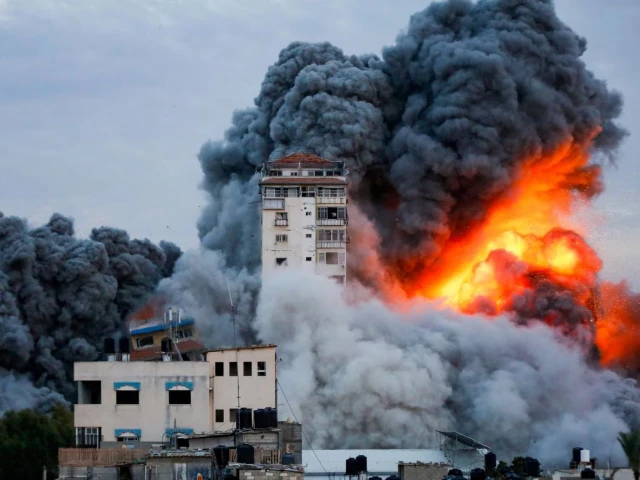
Smoke and flames billow after Israeli forces hit a high-rise tower block in Gaza City on October 7. PHOTO: REUTERS
Israeli forces killed three Palestinians in Gaza near the line demarcating areas of Israeli control on Monday, underscoring the struggle to expand a fragile ceasefire agreement adopted six weeks ago with global acclaim.
Palestinian medics said Monday’s incidents included an Israeli drone firing a rocket at a group of people east of Khan Younis, killing two and wounding another, and a tank shell that killed one person on the eastern side of Gaza City.
The Israeli military said it opened fire after spotting “terrorists” who crossed the so-called yellow line and approached its troops, posing a direct threat to them.
Read more: 22 Palestinians killed in Israeli strikes in Gaza despite ceasefire
Palestinian militant group Hamas and Israel signed a truce on Oct. 9, ending two years of devastating war, but the agreement left the most intractable differences for further talks, freezing the conflict without resolving it.
Both sides have since accused each other of deadly violations of existing commitments in the deal and of backtracking on later steps required by US President Donald Trump’s 20-point Gaza peace plan.
Gaza’s health ministry announced on Monday that at least 342 Palestinians have been killed by Israeli fire since the ceasefire began. Israel says three of its soldiers were killed by militant fire during the same period.
Last week, the United Nations Security Council formally endorsed Trump’s plan, which calls for an interim technocratic Palestinian government in Gaza, overseen by an international “peace council” and backed by an international security force.
Trump’s plan also calls for reform of the Palestinian Authority, based in the Israeli-occupied West Bank.
Negotiations
Former British Prime Minister Tony Blair, who helped the US develop the plan and whom Trump has said may join the peace council, met with Palestinian Authority deputy leader Hussein al-Sheikh in the West Bank on Sunday.
Sheikh said in a social media post that they discussed developments following the Security Council resolution and demands for Palestinian self-determination.
Meanwhile, a Hamas delegation in Cairo, led by exiled leader Khalil al-Hayya, held talks with Egyptian officials to explore the next phase of the truce, according to Hazem Qassem, Hamas’ spokesman in Gaza.
Read also: Pakistan’s bet on Gaza
Qassem acknowledged that the road to the second phase of the truce was complicated and said the Islamist group had told Egypt, a mediator in the conflict, that Israeli violations were undermining the deal.
Agreement on the composition and mandate of the international security force was particularly difficult.
Israel has said the multinational force must disarm Hamas, a step the group has so far resisted without a Palestinian state, which Trump’s plan generally sees as the final stage but Israel has ruled out. Qassem said the force must play a role in keeping Israel’s military away from Palestinian civilians.
“There is complete uncertainty. The Americans have not presented a detailed plan. It is not clear what kind of forces, what their tasks are, what their roles are and where they will be stationed,” said a Palestinian official close to the talks in Cairo, who spoke on condition of anonymity.
“Any deployment of forces without a political trajectory, without consultation with all Palestinian factions and forces in Gaza, would further complicate matters.”
a href=”https://tribune.com.pk/story/2578907/gaza-truce-progress-slow-as-israeli-hamas-violence-persists”>Source link



