
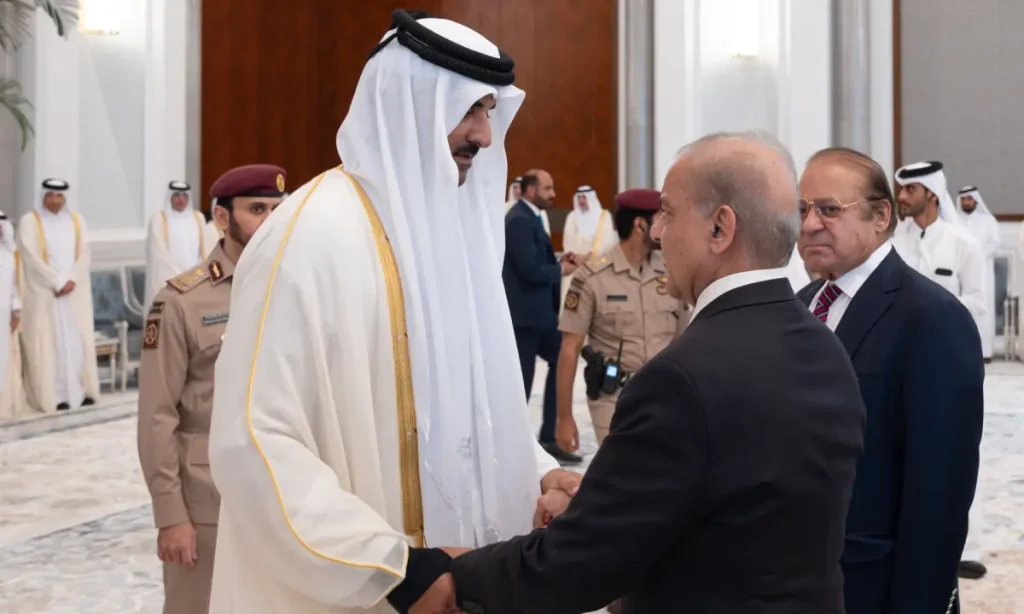
Prime Minister Shehbaz Sharif and Pakistan Muslim League-Nawaz President Nawaz Sharif met Qatar’s Emir Sheikh Tamim bin Hamad Al Thani at Lusail Palace in Doha on July 13, conveying Pakistan’s official condolences on the death of former Emir Sheikh Hamad bin Khalifa Al Thani (Dawn; Geo News; The News). The Pakistani delegation also included Deputy Prime Minister Ishaq Dar and Information Minister Attaullah Tarar.
Shehbaz Sharif conveyed Pakistan’s heartfelt condolences and paid tribute to Sheikh Hamad as a statesman whose leadership reshaped Qatar into “a prosperous, modern and internationally respected country.” Emir Tamim thanked the delegation for the “special gesture of travelling to Doha to personally offer condolences,” describing it as reflecting the “deep-rooted fraternal bonds between the two brotherly countries and peoples.”
In a further mark of solidarity, Prime Minister Shehbaz declared July 13, 2026 a national day of mourning in Pakistan, with flags lowered to half-mast across the country. Shehbaz returned to Pakistan the same evening after concluding the visit, according to the Prime Minister’s Office.
Nawaz Sharif’s inclusion
The inclusion of Nawaz Sharif — the party president and former three-time prime minister — in the Doha delegation signals the importance Pakistan attached to the visit. Nawaz has maintained close personal relationships with Gulf leadership, particularly in Saudi Arabia and the UAE, built over decades of Pakistani political engagement with the Gulf states. His presence alongside the sitting prime minister elevated the delegation’s seniority beyond the protocol standard for a condolence visit.
Qatar’s significance for Pakistan
Qatar is one of Pakistan’s most consequential bilateral partners: a major LNG supplier underpinning Pakistan’s gas import framework, a significant source of remittances for Pakistani workers in the Gulf, and now the expected venue for the next round of high-level US-Iran direct negotiations that Pakistan is co-facilitating. The July 13 Doha meeting — even in the formal context of condolences — provided the two governments an opportunity for a substantive bilateral conversation at a moment when both the LNG supply framework and the Iran diplomacy channel are active and under pressure.



