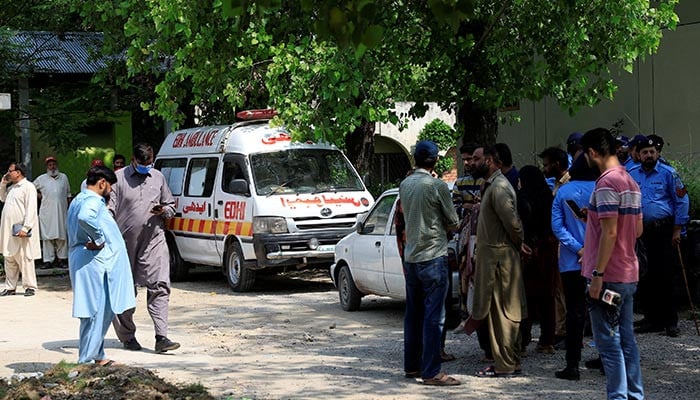
The Pakistan Institute of Medical Sciences held no fire-safety NOC at the time of the fire that killed 14 newborns, Geo News reported on Thursday, citing sources (Geo News).
That claim rests on one outlet and unnamed sources. Geo’s own headline puts “lacked” in quotation marks. The News carried it too, but The News and Geo are both Jang group, so that is one source, not two. No independent outlet has confirmed the missing NOC, and this newspaper reports it as Geo’s account.
What has been reported independently is narrower: a CDA Fire Brigade report found PIMS’s fire prevention and life-safety arrangements inadequate and below prescribed standards (Aaj News). Inadequate arrangements and a missing NOC are not the same finding.
Two regulators, neither one closing the gap
The Islamabad Healthcare Regulatory Authority licenses hospitals, laboratories and clinics in the capital, and fire-safety arrangements form part of its annual renewal. Geo’s sources say IHRA renews without verifying they exist — hospitals satisfy the requirement with photographs of rescue drills held in November and December.
The Capital Development Authority runs the fire-safety inspections in Islamabad, judging hospitals against “applicable NFPA standards, CDA Fire Safety requirements and approved fire safety plans” (Express Tribune).
Geo’s sources say the CDA wrote to IHRA twice, asking it not to certify hospitals lacking fire-safety arrangements. IHRA never replied.
What the NA panel actually said
Mahesh Kumar Malani, who chairs the National Assembly’s Standing Committee on National Health Services, visited PIMS on Thursday and said a “technical fault” may have been responsible. He did not say it was. Dawn quotes him more bluntly: “no one knows the source of the fire” (Dawn).
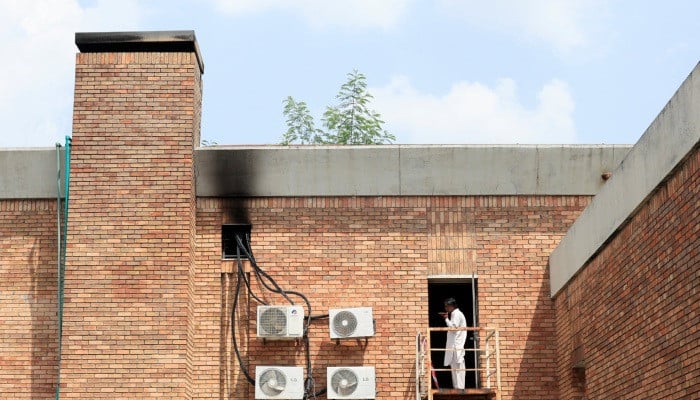
Officials told the committee the fire may have started in an air conditioner — an old unit that had not been working for some time. CCTV footage reviewed by the panel did not show where the fire started (Geo News). The ward dates from 1990. “There should not have been a nursery here,” Malani said.
That date sits awkwardly beside the government’s own explanation. Health Minister Mustafa Kamal told interviewers that sprinklers had never been installed because the 1984 building was technically unsuitable for them, PIMS having been built when Islamabad’s population was around 350,000 (The News). The two men may be describing different structures — the hospital as a whole against the ward that burned — but nobody has reconciled them, and this newspaper carries both rather than picking one.
Not the same finding as the PIMS report
PIMS’s own initial report said a device measuring oxygen flow exploded alongside an incubator in the NICU, and that smoke travelled through pipes into the infants’ airways (Geo News).
The committee has not endorsed that. Dawn lists a fault in the oxygen pipes as one of three possibilities the panel heard, alongside the old air conditioner and a bundle of wires that one doctor said had sparked. The two accounts should not be merged.
Two more capital hospitals, inspected
CDA teams inspected Capital Hospital and the Federal Government Polyclinic on 27 August. Both were found badly deficient (Express Tribune).
Capital Hospital: no smoke-control system in several blocks, no fire-rated doors on escape routes, extinguishers expired or wrongly installed, no sprinklers where they are required, no underground firefighting reservoir, no trained 24-hour fire staff.
The Polyclinic: 34 fire and life-safety deficiencies, exit routes blocked or obstructed, wiring described as extremely poor, a gas leak near the main kitchen, and no proper arrangements for evacuating patients from intensive care, cardiac care or the NICU. ARY News, working from the same CDA audit, reports the same figure of 34 (ARY News).
Neither report says either hospital lacked an NOC. Both describe a hospital that would fail one.
The 15-day clock is in Sindh, not Islamabad
Sindh Chief Secretary Asif Hyder Shah has given provincial departments 15 days to return signed fire-safety compliance certificates for public buildings, after an audit of 3,354 across six divisions (Express Tribune; Dawn). The divisional counts — 798, 1,287, 420, 129, 418 and 302 — reconcile to that total. Tribune alone reports a second 15-day order, to the Sindh Building Control Authority, on 580-plus buildings already declared dangerous.
No comparable deadline has been reported for the federal capital, where the fire happened. Malani’s committee has called an emergency meeting and put its questions to the relevant authorities; he said it would name those responsible “once the report comes.”