
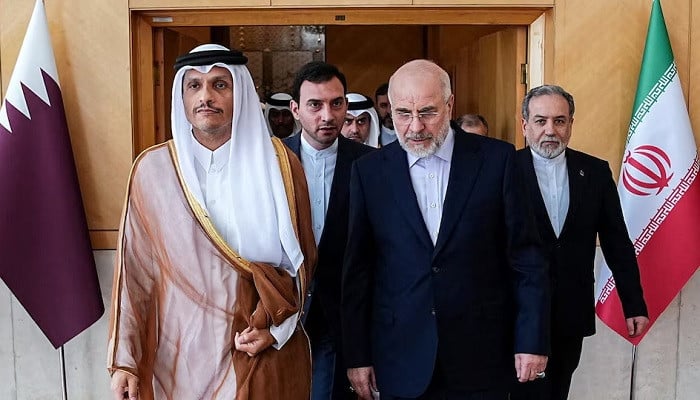
Iran has agreed to draw up a list of conditions for restoring normal traffic through the Strait of Hormuz, after Qatar’s prime minister spent Thursday in Tehran pressing Iranian leaders to respect freedom of navigation (Geo News).
The mission did not produce a resumption of US–Iran talks. Washington says none are happening.
Who met whom
Sheikh Mohammed bin Abdulrahman Al Thani, who is both prime minister and foreign minister, met Foreign Minister Abbas Araghchi, President Masoud Pezeshkian, Parliament Speaker Mohammad Bagher Ghalibaf and Supreme National Security Council secretary Mohsen Rezaei (Al-Monitor).
Qatar’s foreign ministry said the talks covered a proposed phased framework: a temporary joint Iranian–Omani shipping corridor through the strait, plus a joint mine-clearing project (Dawn).
Al Thani said on X he had underscored “the importance of respecting freedom of navigation in the Strait of Hormuz in accordance with international law”. Doha’s ministry separately said he stressed “the necessity of respecting the sovereignty of neighbouring states” (Geo News/AFP).
What Iran said
Rezaei, speaking through an interpreter to Al Manar TV, said Iran was compiling its conditions because mediators had asked it to set them out. Iran and Oman had agreed a corridor running partly through Omani and partly through Iranian waters, he said; ships would use a designated central channel if the US met Iran’s terms.
Iran’s conditions, as stated in the past, have run well beyond shipping: an end to the US blockade of Iranian ports, compensation, and the removal of sanctions. Reuters noted it remained unclear whether Tehran meant to amend those demands into something the Americans could accept. Separately, Rezaei told Al Manar that any understanding on the strait would also have to cover an end to the wars and military operations in Gaza, Lebanon and Syria (CNBC).
Ghalibaf said the US must return to the June memorandum of understanding, the ceasefire deal President Trump declared “over” three weeks after it was signed, IRNA reported (Al-Monitor). Press TV quoted Pezeshkian as saying Iran “will not succumb to pressure and bullying”. Araghchi struck the softest note, writing on X on Friday that “putting diplomacy back on track isn’t impossible” — while adding that renewed talks hinged on Washington grasping “one simple fact: pressure doesn’t work” (CNBC).
What Washington said
The White House said there were no negotiations under way because Tehran had not “come to the table in a meaningful way”. Press secretary Karoline Leavitt said on Thursday that Trump “continues to retain all options on the table” (Dawn). Iran says it has never left the negotiating table. The administration is instead running a secondary-sanctions campaign against Iran’s trading partners.
That is also the problem with Ghalibaf’s demand: the Wall Street Journal reported on Thursday that Trump is no longer interested in the June framework at all, and is waiting to see whether economic pressure works (CNBC).
Separately on Friday, Central Command chief Admiral Brad Cooper said internationally recognised transit routes were “free of Iranian sea mines” and that US forces had escorted nearly 1,500 commercial vessels carrying about 750 million barrels of crude (Arab News).
Traffic tells a different story. Ship-tracking services estimate activity at roughly 5% to 15% of normal volumes, Reuters reported — a lower range than the “about one-quarter of pre-war level” the same wire gave for oil flows a day earlier. The strait carried a fifth of the world’s oil before the war. The UN’s International Maritime Organisation has logged 70 incidents there since the war began in late February, killing 19 seafarers, according to the same report.
Iran has not yet handed its list to anyone. Whether it arrives shaped for an American yes, or as the same demands in a new envelope, is the next thing to watch.



