
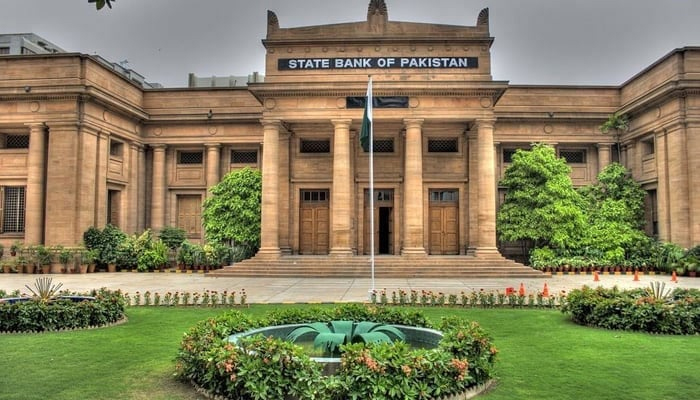
Pakistan’s macroeconomic conditions improved during the financial year 2023-24 due to several reasons, including the successful engagement with the International Monetary Fund (IMF).
In its Annual Report on the State of Pakistan’s Economy for the financial year 2023-24, the State Bank of Pakistan (SBP) said that apart from the IMF commitment, the economy was also supported by stabilization policies, reduced uncertainty and a favorable global economy environment.
An increase in domestic agricultural productivity also contributed to relatively better macroeconomic results during the year, the report added.
Real GDP registered a modest recovery due to agriculture in the 24th year. Record wheat and rice harvests and a rebound in cotton production mainly provided a boost to agricultural output during the 24th year.
The report highlighted that despite the recovery in real economic activity, the current account deficit narrowed further to a 13-year low as strong growth in remittances and exports more than offset a slight increase in imports.
This, combined with the stand-by arrangement with the IMF that has dampened inflows from other multilateral and bilateral sources, has helped to build up foreign exchange reserves and calm sentiment in the foreign exchange market.
The gradual appreciation of the exchange rate during the year, combined with higher-than-expected fiscal consolidation, led to a marked decline in the government debt-to-GDP ratio in the 24th year.
Monetary policy, inflation
The SBP report noted that the SBP maintained a tight monetary policy by keeping the policy rate unchanged at 22% for almost the entire FY24.
He also introduced reforms to foreign exchange companies, following administrative actions by the government to bring order to the foreign exchange and commodity markets. The government continued fiscal consolidation, with the primary balance showing a surplus for the first time in 17 years.
These, along with a decline in global commodity prices amid improved global economic activity and trade, had a positive effect on key macroeconomic indicators, the report said.
Inflation fell from a peak of 38% in May 2023 to 12.6% in June 2024. It averaged 23.4% in 2024, significantly lower than 29.2% in 2023.
A sustained decline in headline and core inflation in 2H24 has created scope for the SBP to cut the policy rate by 150 basis points to 20.5% in June 2024, it added.
Structural barriers
Despite these positive developments, the SBP report highlighted that a number of structural obstacles continue to pose challenges to maintaining macroeconomic stability.
Decline in investment amid low savings, unfavorable business environment, lack of research and development and low productivity, alongside climate change risks continued to limit the growth potential of the economy.
In addition, long-term inefficiencies in the energy sector have resulted in the accumulation of cyclical debt.
While the government began to address the challenges of the energy sector through substantial price adjustments, there was a need to broaden the scope of these efforts by introducing sectoral policy and regulatory reforms.
These reforms were also necessary to address the issue of state-owned enterprises (SOEs) inefficiencies that continued to drain fiscal resources, which were already constrained by the low tax-to-GDP ratio.
“Reform of State Enterprises”
In this context, the SBP report also included a special chapter on “SOE Reform in Pakistan” which sheds light on the country’s historical and current experience of SOE reforms.
The chapter also proposed measures for the successful reform agenda, based on international best practices.
Apart from the necessary focus on sectoral policy, these also included effective implementation of recently introduced corporate governance reforms, creating a competitive environment and ensuring effective regulation supported by broad political consensus, the report said.
The economy is expected to improve
The SBP report highlighted that the improvement in Pakistan’s macroeconomic conditions in FY24 was expected to maintain momentum in FY25.
The approval of the Extended Fund Facility (EFF) program with the IMF in September 2024 was expected to further strengthen the country’s external account position, improve the sovereign’s creditworthiness and boost investor confidence.
At the same time, the country was expected to benefit from a favorable global economic environment as inflation eased in advanced economies while global economic growth was expected to remain stable.
Additionally, while there are upside risks to global commodity prices due to rising geopolitical tensions, commodity prices have continued to be subdued. These factors will keep the current account deficit within the range of 0%-1% of GDP in year 25, the report said.
Inflationary pressures to weaken
According to the report, continued fiscal consolidation efforts and the lagged effect of tight monetary policy were expected to further weaken inflationary pressures in the 25th year.
In addition, recent results suggested that average inflation will fall below the previously forecast range of 11.5%–13.5% in the 25th year.
Further, the SBP report added that continued fiscal consolidation was also expected to support further reduction in inflation. In addition, relatively lower borrowing costs and a gradual recovery in the LSM and services sectors were projected to support real GDP growth in the 2.5%–3.5% range in FY25.
a href=”https://www.geo.tv/latest/569506-pakistans-successful-engagement-with-imf-improves-macroeconomic-conditions-sbp”>Source link



