

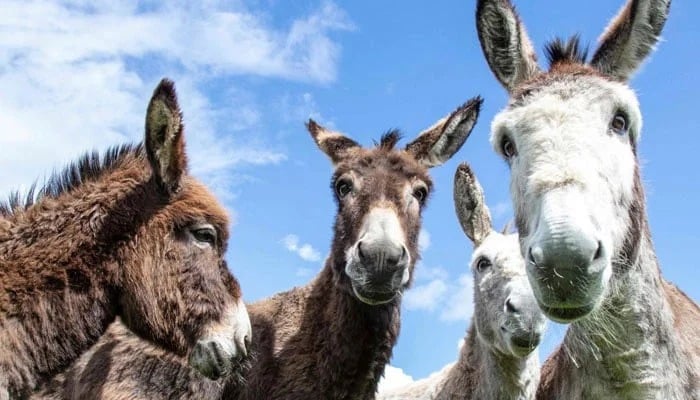
- The president of NA’s body challenges why Pakistan cannot export live donkeys.
- Suggested reproduction of high quality donkeys for the maintenance of the population.
- MNFSR officials say more donkey slaughterhouses are likely in the country.
ISLAMABAD: Ministry of National Food and Research and Research (MNFSR) officials confirmed on Thursday that a recently established slaughterhouse in Gwadar has begun to produce to meet the demand for donkey meat, bones and hides in China for traditional construction. Product. e-jiao.
The National Assembly of Food Safety Committee, chaired by Commission President Rana Muhammad Hayat, Conoved, during which officials have revealed that China has reduced the agreement with Pakistan to supply Slaughter Paul .
A Chinese company has started businesses at the Gwadar, marking an important step in this unusual export sector, the Commission was informed.
When Hayat questioned why Pakistan does not export live donkeys instead, officials explained that the supply of living animals was provocative and less viable than the export of their by -products.
MNFSR officials further revealed that applications for the creation of donkeys in other parts of the country were also falling, while the negotiations were ongoing with other Chinese companies that wished to invest in trade.
As the debate continued, the chairman of the committee noted that donkeys, as soon as the support of the transfer of small loads, lost their importance as a load beast, leading to a reduction in their home use.
With the same breath, Hayat suggested that the selective reproduction of high quality donkeys should be encouraged to maintain their population-given their possible economic value.
Pakistan’s donkey population is about 5.9 million, with China being an important market where donkeys are used in the kitchen and skins to produce e-Jiao, a traditional pharmaceutical gelatin.
Previously, exports were reduced due to delays to finalizing the necessary protocols that have been completed.
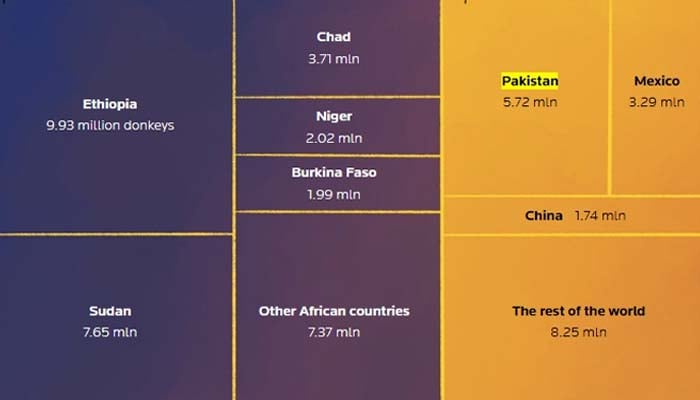
Reporting the animal living groups and veterinary experts, Reuters, in an report published last year, said China’s demand for e-Jiao supplies the slaughter of millions of donkeys each year.
What is e-jiao and why do Chinese elites love it?
E-Jiao, made with collagen extracted from donkey skins, is a vital ingredient in food and beauty products that are believed by many Chinese consumers to enrich blood, improve the immune system and prevent diseases.
Being a luxury product, the e-Jiao gained thanks to the elites during the Qing dynasty that ruled China from 1644 to 1912. The broadcast in 2011.
Its price has jumped 30 times in the last decade from 100 yuan per 500 grams to 2,986 yuan ($ 420), according to Chinese state media.
E-Jiao industry needs 5.9 million donkeys a year
The E-Jiao industry requires about 5.9 million donkey skins a year, which has exerted unprecedented pressure on world populations, according to a report published in February by Donkey Sanctuary, a British charity dedicated to its prosperity.
E-Jiao has a 3,000-year history in the northern Shandong province, according to the government-backed China Daily. The province represents about 90% of China’s e-jiao production, he said.
It is considered as a “national cultural heritage” and is one of the most important products of the traditional Chinese medical industry, according to Chinese state media.
Four companies dominate the e-Jiao sector, according to the Johnston report in China-Africa, with Dong-ee-Jiao representing about 60% of total production, the FU brand that controls 15% of the market and Taiji and Tongrentang Ejiao to check 10% each.
What happened to China’s donkeys?
The population of China’s donkeys has decreased more than 80% to just 2 million from 11 million in 1992, urging the e-jiao industry to come from donkeys from abroad.
In recent years, China has begun looking for countries such as Pakistan and Afghanistan to supply donkey skin. Most donkeys sent by Pakistan to China are part of a secret trade, said Muhammad A Kavesh, director of the South Asian Research Institute at the Australian National University.
For example, in 2022 in Karachi, a mission was seized with nearly 10 metric tones of donkeys in Hong Kong. The mission was initially declared to carry salt and scarves, Kavesh said.
Unlike pigs and cows, however, donkeys are too late to reproduce, say animal experts. Females, known as Jennies, are pregnant for about 11-14.5 months and then usually give birth to only one foal.
The creation of a farming system capable of providing the complete 5.9 million skins needed annually to make e-jiao could last for more than two decades, the sacred thistle said.
– with additional entry from Reuters
a href=”https://www.geo.tv/latest/589364-pakistan-enters-donkey-meat-hides-exports-as-demand-surges-in-china”>Source link



