
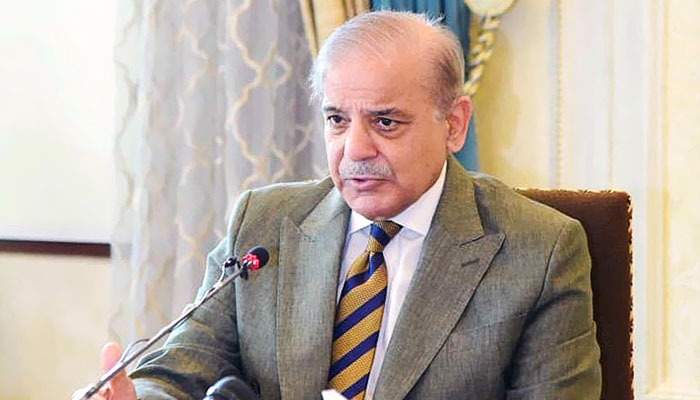
- Prime Minister Shehbaz hopes it will be Pakistan’s last IMF loan.
- He argues that the country will enter a new era after an agreement is reached.
- FinMin says structural reforms, self-sufficiency are key to staving off debt.
Prime Minister Shehbaz Sharif said his government is working to implement International Monetary Fund (IMF) conditions to complete the $7 billion loan program, which he hopes will be the country’s last.
Pakistan and the IMF reached an agreement on the 37-month loan program in July. The IMF said the program is subject to approval by its executive board and receiving “timely confirmation of the necessary financing assurances from Pakistan’s development and bilateral partners.”
“Once the IMF board approves the program, we will enter a new phase,” the prime minister was quoted as saying by Reuters on Tuesday, adding: “We are working to implement all the conditions for the IMF program.”
In August, Moody’s said Pakistan’s default risk has declined to a level consistent with a Caa2 rating, according to Moody’s. “There is now greater certainty about Pakistan’s sources of external financing, following staff-level agreement with the IMF on 12 July 2024 for a $7 billion 37-month Extended Fund Facility (EFF).”
However, Pakistan’s loan approval was not on the agenda of the latest IMF Executive Board meeting schedule, which is a cause for concern as this loan deal is critical for the country to prop up its sinking economy.
On the other hand, the government is optimistic that the country will secure approval for a $7 billion rescue package from the IMF next month.
Meanwhile, in a televised message today, Federal Minister for Finance and Revenue Senator Muhammad Aurangzeb said that Pakistan had already signed a Staff Level Agreement (SLA) with the IMF and was in advanced stages of securing executive approval of the agreement. of the IMF. commission.
While he shared the Prime Minister’s hopes that this would be the last IMF program, Aurangzeb warned that it would depend on the country’s structural reforms and self-sufficiency.
The finance czar reaffirmed the government’s determination to advance the reform agenda, aimed at broadening the tax base and the right of the federal government to achieve macroeconomic stability, which he called “basic hygiene” for sustainable growth.
He vowed to press ahead with plans for new retail taxes despite threats of strikes as a step towards getting International Monetary Fund (IMF) board approval for the loan.
The taxes, in line with ambitious revenue targets adopted to reach a staff-level agreement on the IMF’s 37-month program, faced a public backlash after being introduced in the June budget.
“One thing I want to be very clear (about) … This is not going to be taken back,” Finance Minister Muhammad Aurangzeb said in a televised address urging wholesalers, distributors and retailers to contribute to the economy.
The comments follow a nationwide strike by retailers last week to demand the withdrawal of the new tax regime and high electricity rates, the latest protests in recent months against new tariffs, taxes and inflation.
Although Muhammad Sharjeel Goplani, president of a traders group, the All-City Tajir Ittehad Assocation, had threatened an indefinite strike if the demand was not met, no further action has been announced since then.
Board approval of the Fund is contingent on confirmation of funding guarantees for Pakistan from development and bilateral partners.
Local media reported that the approval was delayed due to a lack of additional funding and unpaid subsidies in the energy sector announced by the eastern Punjab province and the federal government.
In a statement, Punjab Information Minister Azma Bukhari said the federal government and IMF had not contacted the province about electricity subsidy and the Fund had not issued any written statement.
The IMF, finance ministry and energy ministry did not immediately respond to a request for comment.
Relieving outstanding debt in Pakistan’s power sector is a key concern of the IMF, which ended a $3 billion bailout in April that led to higher tariffs, hitting the poor and middle class and reducing household use for the first time for 16 years.
a href=”https://www.geo.tv/latest/562414-pm-shehbaz-says-govt-working-on-imf-conditions-for-a-loan-deal”>Source link



