
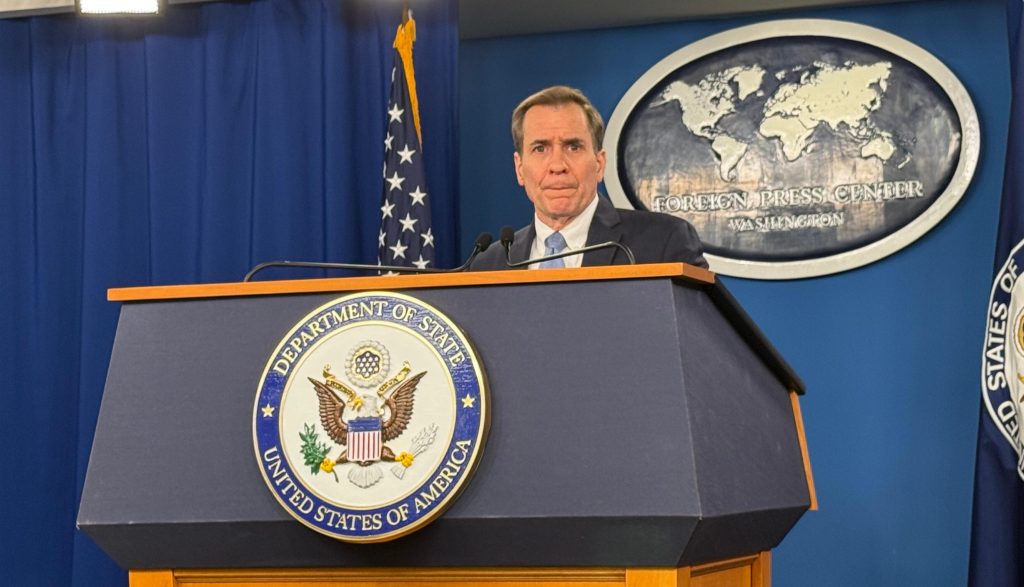
Washington, D.C. – In an unprecedented statement, U.S. National Security Council spokesperson John Kirby asserted that Pakistan had “never been a technical ally” of the United States, emphasizing that there was never any formal treaty of alliance between the two nations. Kirby clarified, “Over the years, especially in the last two decades, we have partnered with Pakistan where appropriate to address the persistent terrorist threat along the shared border with Afghanistan.” He acknowledged Pakistan’s continued struggle with terrorism, highlighting that the U.S. remains committed to cooperating with Pakistan on these mutual security concerns.
Kirby’s remarks came amid a series of sanctions imposed by the Biden administration, particularly in its final year. The most prominent measure involved the U.S. Department of State sanctioning Pakistan’s state-run National Development Complex, an institution tied to missile development, underscoring ongoing tensions over Pakistan’s military advancements.
Despite Kirby’s comments, both the U.S. Department of Defense and the State Department have historically categorized Pakistan as a key non-NATO Major Ally, a status that underscores the importance of bilateral cooperation on regional security, despite the absence of a formal alliance. Pentagon spokesperson Major General Patrick S. Ryder reiterated this position, emphasizing Pakistan’s role in counterterrorism operations, and reaffirming the continuation of discussions in this critical area.
Tensions between the two countries became more apparent in late 2023. Following violent protests in Islamabad on November 26, U.S. State Department spokesperson Matthew Miller expressed concern, calling for peaceful protest and respectful government engagement. Later, on December 23, the U.S. voiced deep unease over the trial of civilians in military courts, citing the lack of judicial independence, transparency, and due process.
A significant flashpoint emerged regarding Pakistan’s ballistic missile program, which has long been a concern for U.S. officials. The State Department’s December sanctions against Pakistan were framed as a direct response to Pakistan’s advancing missile capabilities, which are perceived as a growing threat.
On January 19, U.S. Deputy National Security Advisor Jon Finer warned that Pakistan’s pursuit of increasingly sophisticated missile technology poses a potential threat beyond South Asia, including to the U.S. homeland. Speaking at an event hosted by the Carnegie Endowment for International Peace and the Arms Control Association, Finer characterized Pakistan’s missile activities as an emerging concern for U.S. security.
While U.S. officials acknowledged that Pakistan’s ability to deploy long-range ballistic missiles is still several years away, they also revealed that Pakistan had rejected proposals for confidence-building measures, including sharing telemetry data on missile tests. The discussions, though limited in scope, reflected the growing strategic divergence between the two nations.
Throughout the Biden administration, U.S. policy toward Pakistan has remained cautious, with few high-level diplomatic exchanges and a focus on military cooperation. However, as the administration entered its final months, there was an evident shift in tone, with increasing scrutiny of Pakistan’s military leadership and its role in regional security dynamics. This shift signals potential challenges ahead for U.S.-Pakistan relations, as both nations navigate their evolving priorities and security concerns.



